
Posted in Teaching Thoughts

The Need for Reflective Teaching

Teaching is a fast-paced career that is both extremely rewarding and extremely challenging. Daily tasks that must happen outside of teaching time (you know, that 50ish-minute plan time) include creating engaging lessons, grading papers and contacting parents. This is a large amount of important and essential work, but most of a teacher’s day is actually spent teaching students content while building positive relationships with those same students as we work to create a classroom environment that is positive and conducive to learning. This job of teaching is one that requires being adaptable, flexible and present during each and every teaching moment; regardless of all the other work that must be completed.

  Many times, we as teachers feel as if we cannot handle even one more thing to do because many of us are constantly trying to catch up or stay caught up with our work. We work in the evenings; we work on the weekends and we sometimes work in the summers. We do this all for our students and the career we love, but an important piece of the job is missing from the tasks I mentioned. To get to this missing piece of the job I want to explain the journey I took to adding this piece into my daily practice.

I am a person who was taught from a young age to always strive to excel at whatever I am doing. When I was an undergraduate student at Pittsburg State University, I had a professor explain National Board Certification to a group of us aspiring teachers on the way back from a field trip. It isn’t a mandatory certification to receive and many wonderful teachers never seek out this distinction. Earning this certification shows that students learn with you; the true job of a teacher. National Board Certification shows others that you are an accomplished teacher – a master teacher even. Earning this certification means you demonstrated meeting national standards for excellence in teaching. I immediately put National Board Certification on my professional bucket list of things to accomplish before I retired. This dream gave me the goal to work on providing the best learning environment possible for my students while helping them grow in their math skills.

Several years ago, five to be exact, I began my journey to become National Board Certified. I chose to work on my National Board Certification because I believed that I was a pretty good math teacher who had a wonderful classroom environment and was overall successful with helping my students learn math. (There are always the SUPER hard to reach kids, but we will discuss that in a laterpost.) I began my three-year journey thinking I was simply going to prove what I hoped was the case – that I was a really good teacher. I should note that my journey took three years because I began it during the time when the process was under revision and I had no choice in my timeline. I honestly cannot imagine doing it in less time, but that is now an option for new candidates.

What I learned from this three-year journey is that self-reflection is an essential part of our teaching jobs and I don’t think any of us truly do this often enough. A huge part of the National Board Certification process is looking at every aspect of your teaching practice and defending how you know your students are learning. There are video tape components where you analyze the exact moments students are learning the objective of that day. There are written components that analyze your teaching practice in how you differentiate for each student in class. There is a several part written component about your assessment structure and how the results are used to further student learning over the rest of the school year.

Over the course of those three years, I have never looked so deeply into what actually goes on in my classroom. I don’t mean looking at the tests scores students receive or the behavior management that needs to be in place to keep the learning front and center during each lesson. I am talking about looking at how each student is learning and how you know when they fully and truly understand a concept. I am talking about critically looking at how your lessons are structured so that the quiet kids who understand that material right away are learning as much as the quiet and reluctant learners. I am talking about reflecting on how you assess your students and deciding if it is more than just having students demonstrate their knowledge at a basic level. I had to look deeply at everything I was doing as a teacher, what my students were learning and how could I prove that learning was taking place.

My journey to prove my teaching ability was a success in more ways than one. I earned my Adolescent and Young Adult Mathematics National Board Certification in December of 2017. As I have moved forward with that really exciting accomplishment, I realize that I gained so much more out of the experience in terms of how I run my classroom. I am now in the daily habit of reflecting over my lessons and their results. I designed my own planner pages so that I could keep notes of what I needed to change for the next year. I took note of student reactions and learned to better read body language to tell the difference between the quiet kids who understands and the ones who just act like they understand. My journey to National Board Certification has made me more of a reflective teacher and I couldn’t be happier.
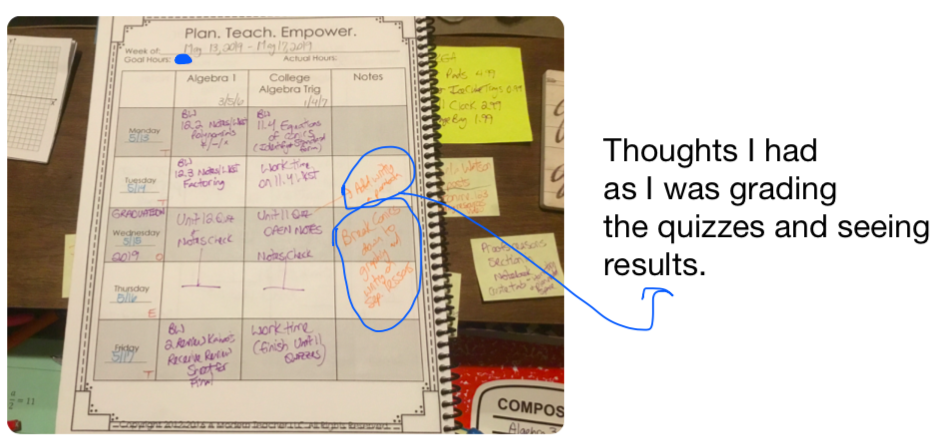
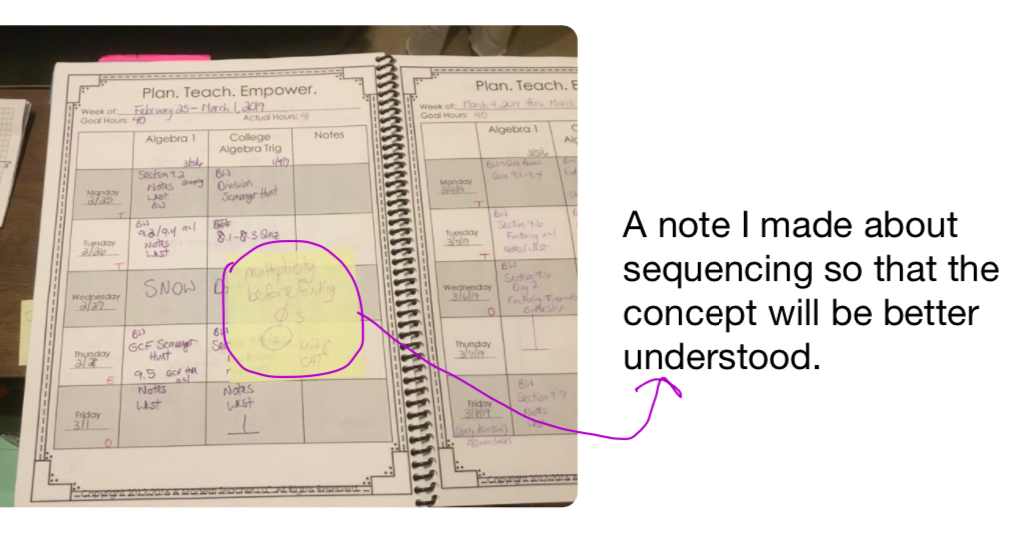
Becoming focused on my daily reflections has helped me really look at what’s best for my students. The job of teaching is really about working with kids and doing what is best for them while trying to teach them content along the way. If we as teachers come to the point where we are simply reusing everything year to year, are we really meeting the needs of our students? If we as teachers continue doing the same lessons and same activities every year, are we serving our students’ needs or our own? There is nothing wrong with reusing items from year to year, but does it hurt anything to simply look them over with our current students in mind? Does it really hurt anything to make a small change or adjustment that will make things better? Trust me, investing your time in this way has huge pay-offs.

There are so many easy ways to bring self-reflection into your daily teaching practice.  I mentioned my self-designed planner that gives me an automatic thinking space each day for a quick note. I have plastered the space behind my classroom desk with sticky notes of things to change in upcoming lessons based on that year’s student needs. I have started a running word document to track how engaging my activities really are and what I can do to increase the accountability level or changes I need to make to increase the enjoyment. I have taken note of student opinions feedback and let this drive changes that are student centered and beneficial.
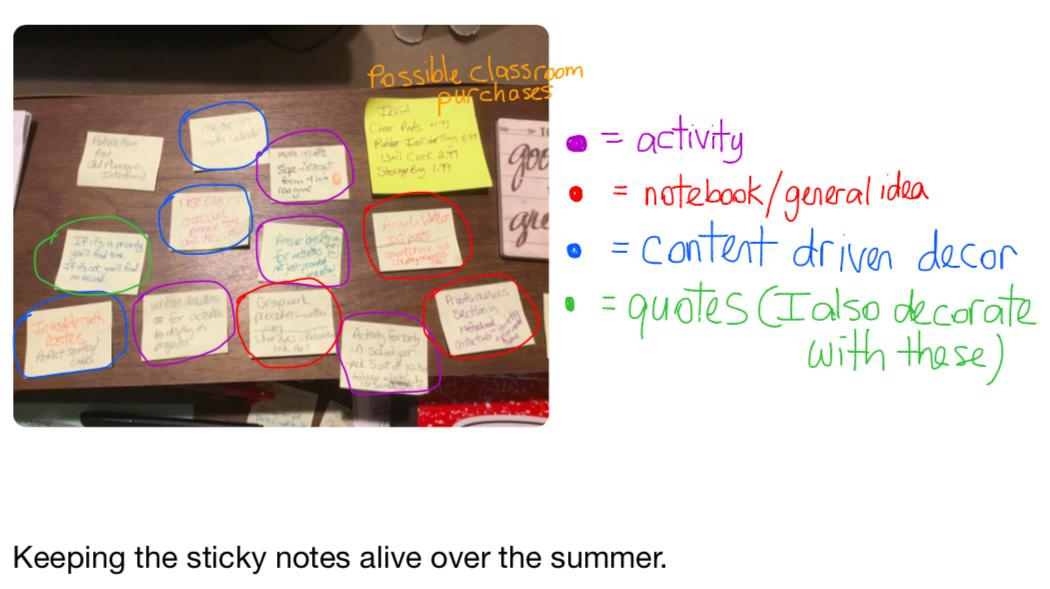
If we as dedicated teachers truly look at what goes on in our classrooms from August to June, can each of us say that everything we do is in the best interest of our students and leads to learning? How many of us encourage our students to do self-reflections? Shouldn’t we lead the way by building this into our daily routines? I know teaching is extremely busy, busy, busy. My family lives it right along with me from August to June. I have noticed that my engagement has increased over the last couple of years when I have taken the time to make the changes I noted during a lesson or activity. I have had a few more students struggle a little less with some challenging topics such as factoring and solving quadratic equations by taking note of the exact places of struggle and finding ways to offer a different explanation or find just one more example to help solidify the steps. These are just a couple of the many pay-offs that self-reflection has brought to me, my teaching practice and my students.

We as teachers are a busy and dedicated group of professionals. I promise the daily practice of self-reflection is a worthwhile use of our time. I am continuing with daily reflection this coming year and am looking at new ideas to streamline the process and make it personally effective. I plan to categore my observations into groups so that so that I address things in groups, such as teaching strategies, or on an individual basis, like one of my many activities.

It took the three-year journey of National Board Certification to understand what self-reflection means to me and my students. I can honestly say that I am glad for this change and cannot imagine not working to improve my craft using the help of my own observations. When we take the time to critically look at what we are doing, we will make changes for the better each and every time. Self- reflection is a powerful teaching tool and I hope that more teachers join me in this game-changing practice.

Posted in Teaching Thoughts

I LOVE TEACHING

There are two things that I truly love to do in this world besides spending time with my wonderful and amazingly large family (when you add in all my brothers, sister, nieces, nephews etc). I love to bake desserts of just about any kind, and I love to teach. I don’t love teaching in the sense that it’s my chosen career, so I need to put my very best forward every day. I don’t love teaching in the sense that it’s my chosen career and I do sincerely enjoy it year after year. I mean that I LOVE teaching. I am that teacher who can’t help but shop the clearance sections year-round for deals on school supplies. (Trust me, they pop up at random times and my sons are always rolling their eyes at me.) I am the teacher who has well over 3,000 separate teaching ideas saved to her Pinterest account out of a total of 5100 saved ideas. I am the teacher who knew in kindergarten that she was meant to be a teacher and I followed that dream. I am the teacher who enjoys learning and has a career that needs me to do so on a continuous basis. Simply put, I LOVE teaching.

I started thinking about just how much I love teaching last week as I read the first part of Teach Like A Pirate by Dave Burgess. I felt as though his words were truly speaking to me. He writes about the difference between enthusiasm for something and having true passion for it. His words got me thinking about my true feeling about teaching, and the other main interest I have in my life. (Besides my amazing family of course – they are a category all on their own.) He goes on to explain the different kinds of passion within a career and how they all work together to create an effective person. (I won’t spoil anymore of it for those of you who want to read this fabulous book.) Dave Burgess’ words showed me that teaching really is my true passion.

I know that I really like to bake. I find real happiness in making treats that others can enjoy. I spend quite a bit of time over breaks searching for new dessert and bread recipes. I always have my kitchen stocked with the ingredients to make chocolate chip or peanut butter cookies at a moment’s notice. Baking cookies is relaxing to me, and I spend the first several days of my winter break every year making cookies and other treats to mail out and share with several people. As I was reading Teach Like a Pirate, I began to think about whether or not I have personal passion for this hobby of mine. I realized that while I do truly love baking, I wouldn’t say I am passionate about it; at least not the same way I am about my teaching practice. If I don’t get to my plans to bake over the course of a weekend, I don’t feel as though I have left something unfinished. I don’t feel as though I have missed out on anything. The baked goods would have been nice but going without sweet treats isn’t going to hurt anything.

As much as I promise that I do enjoy my weekends and breaks from my teaching job (I get to hang with my two boys and hubby), I have to admit that I spend a lot of time trying to improve my craft. I feel like I need to be looking for ways to do a better job at reaching all learners, especially my high achieving learners. I am always on the lookout for a new activity, strategy or even classroom decoration. I believe that when I am feeling effective and prepared, my students are receiving the best of me and have a chance to really learn what I am teaching them.

Less important ways that I know teaching is important to me include how I set up my space. I have a huge collection of pens so that I can pick a grading color based on whatever I want. (Seriously, I probably have way too many pens.) I color code my lesson plan book and my grade book and think about ways I can make my classroom an inviting and ultra-organized place. Many, many students have expressed how much they enjoy the way my classroom is happily decorated. All of these little things do scream enthusiasm for the job, but as I learned during this past spring semester, my feelings about my teaching go much deeper than even I expected.

I lost count of the number of times I started class with the excited words “Guess what? I found a new activity for us to do!” It wasn’t just me trying to pep up my students, I was sincerely excited to join in on the ‘fun’ that I had prepared. Nothing gets me fired up quite like a hands-on math activity that will help my students have fun while learning math.  My students were able to quote me on this phrase long before the end of the 1st quarter of school was completed.

I spent hours and hours over the course of the last year reading books, articles, tweets and blogger posts searching for anything magical that I could take back to my kids – yes, my students are also ‘my kids’. I truly want each student in my room to find success with a subject that most of them hate, math, and to do this I need to be a learner myself. 

The very biggest reason that I know I am passionate about teaching is how much I missed it and my kids when I had to turn things over to my student teacher this past spring semester. Luckily, I was assigned a super competent and wonderful student teacher whom my students liked a lot. And sure, I got to spend hours and hours prepping activities, creating a colorfully themed bulletin board and looking at curriculum for the coming school year while he taught my classes and graded the papers. It was awesome to end the school year with a feeling of being a tiny bit prepared for the coming school year. In the end though, I missed my kids. I missed listening to them groan when I reminded them why I want them to show their math work. I missed the guilty looks when homework wasn’t completed. I missed the complaining about math being too hard and boring. I missed the looks of joy when a student who struggles had their lightbulb moment with a new concept. I missed the students rushing into my room to share things about their day with me. I missed working math problems with my students and explaining ways to make them easier. I missed answering homework questions and helping to ease confusion. I missed planning my units. I just missed my job – even though I do enjoy working with future teachers. 

Teaching is in my blood. Teaching is an essential part of me. Teaching is what I do and who I am. Even on my bad days, I know my students are seeing a happy Mrs. Bledsoe – because they tell me this all the time!! “Why are you always so happy?” “How can you love this job so much?” My enthusiasm and passion for my job cannot be faked. I love helping my students learn math. I love working with my students and seeing them grow. Teaching is a huge and essential part of my life. I can’t imagine doing anything else. Simply put, teaching is my passion and I LOVE teaching.

Posted in Math Teacher

Why I Love Education/Teacher Books

I was at an in-service last week and heard from one of the many terrific presenters that right now is a great time to be a teacher. He went on to explain that currently there are so many books for teachers to read that anyone can find something of interest; something that will give them a new nugget of insight to improve their craft. I immediately agreed with this thought. This time of great thinkers and movers in the education world means anyone can find something of interest to read! Everyone can find a way to improve their craft and make their classrooms a better place for kids!! Of course, as I say this I am reading three different education books in the hopes of finding a new nugget to make the next year better.

Why do I read educational books instead of just looking for strategies or activities? Why do I read books instead of choosing the ever popular Podcast format? One reason is that I LOVE TO READ. I have been an avid reader since I finished my first Laura Ingalls Wilder book in 2nd grade over thirty years ago. Give me a comfy chair and a stack of books and I am a happy girl. Another reason is that I do think that many teachers are readers at heart; after all, how many of us read book after book in our undergrad and graduate degree studies?

I think the issue that many educators face is that they have forgotten how rewarding their own reading can be due to how busy we get during the school year. When faced with a stack of 60 tests to grade for anxiously awaiting students, most teachers will choose the tests over reading something to improve the school year. We have also read so many assigned books in the pursuit of our degrees that many teachers finish their Master’s Degree and declare they need to take a break from reading. Is it really a break from reading they want, or is it a break from being told what to read?

We as teachers need to carve out time to work on our craft. How many times have we all heard the phrase that teachers build life long learners. Shouldn’t we as teachers model that life-long learner attitude? Should we ever reach a point where we feel that our classroom is running just fine and no need for improvement is needed?

Reading education books is a way to hear from other teachers. Teachers by the dozens (maybe more) are writing books about their experiences and the ways that they have improved their teacher practice. There are also books about reconnecting with our love of teaching. Teaching is a HARD job. We are under fire from so many different directions that this career path is not for the faint of heart. With that in mind, shouldn’t we carve out a way to give ourselves some quiet time and maybe make our jobs a little easier by discovering a new ‘nugget’ to make our kids into better learners.

With all of the books that are in publication and all the books that are to come, I hope that many of my fellow teachers can reconnect with their love of reading. Of course it doesn’t have to be simply educational books that are read – we should get to have some fun reading too. I just know that this super-duper busy teacher plans to carve time out for reading in the coming school year that I can justify as work based. It might just ease that conscience of mine when I decide to read instead of finishing the grading on that stack of 60 tests.

Posted in Introduction

My New Project

My name is Heather Bledsoe. I have been a teacher for 17 years now – 14 of those mathematics. I earned my National Board Certification in 2017 and have decided to start keeping a record of my reflections as the coming school year begins. I hope you will join me on my journey.