Posted in Teaching Thoughts

Make LEARNING Important Again

Standing on the doorstep of a new school year, I am facing my normal anticipations and jitters. What will my new daily routine look like once the school year gets going? I know my preps and assigned hours, but the schedule surronding those preps flushes out once the year gets going. What will my new students be like? Will I be able to connect with them to form working partnerships? What will the tone of the school building be for the coming school year? How will the parents respond to my communications and classroom expectations? How will I help my students learn?

That last question, how will I help my students learn, is the one that drives me as a teacher. I search for new activities to expand my repetoire year round and read up on ways to help students to better retain information. I look into instructional methods that can reach more learners and work on redesigning assignments to offer enough practice on both old and new concepts. I design my classroom as a happy and inviting space, with places to look for content refreshers within my word walls.

I am fully invested in helping each of my students learn as much as they can over the course of the school year. I believe that learning is essential for each and everyone of us, so that we have the background knowledge to be able to seize every opportunity we are presented with throughout our lives. The problem that I have been encountering lately is that many students, and even some parents, are not focused on the true purpose of school – learning. School is still important, but it isn’t for academic based reasons. Social activities, athletics and grades are more important to many students than learning.

The problem with grades is that people have come to equate grades with learning, and the drive for passing and receiving exceptional grades exists even more than in years past. People want students to have high grades, and students are driven to have great GPA’s for the promise of acceptance into select colleges or programs. Others keep their focus on earning at least 60% in a course so that credit can be earned and graduation achieved.

The problem with the focus on letter grades is that grades often don’t equate to learning – and this is a systematic problem. Teachers are now being questioned about why students aren’t achieving higher grades – which has led to this culture of retaking tests and extensions on work. Teachers are being asked to do what is necessary to help students pass – but that often equates to teachers doing more work than the student.

Where is the concern about the learning? When did it become to be okay to just worry about an end result – a grade or test score – and not worry about what those mean? I see this contradiction all of the time at the secondary level in the form of ACT scores. The ACT, a very popular standardized test for college admission, is a test that measures content knowledge and skill. When students have high grades in their regular coursework, but can’t apply it to a standardized test, learning hasn’t happened. (I know what is said about test anxiety, but that is another post for another day.) If students don’t have a solid base in content across their academic subjects, things such as high scores on standardized tests are difficult to achieve.

Another way that I see people forgetting the importance of learning is the increased dependance on and use of technology. Teachers are encouraged to use technology to “support” learning, when we are really being encouraged to use the technology to replace paper and pencil. We are told that using technology is the key to fostering student engagement, that it helps to meet the students where they want to learn. A lot of the online resources, apps and programs are more gamelike that anything else. These are fun and suit a purpose, but often don’t equate to real learning.

Another issue with technology use is that students do not know when to keep it put away or to even attempt work without the use of some sort of aid. Looking things up and relying on prior knowledge is becoming more and more difficult to foster in the classroom, as students have come to depend on just finding short cuts on their computers or phones. Students demand to have music in their ears at all times to help them work better, but then often get lost in their playlists choosing the ‘perfect’ work song.

Learning has gotten lost AS the important part of school, and we need to change the focus of school back. We need to keep our kids off of devices so that teachers have a chance to help them learn free of constant outside stimuli. Students need time to process information without the distraction of the constant stimuli they surround themselves with. We need to send a message to our kids that learning is at least as important as their grades are as an outcome to the work they should be doing.

We need to make learning important again. Our kids will be better off in the long run if we encourage them to LEARN, not just drift through school simply doing enough to get by or hoping to reach a certain grade. Learning is the key to having a fulfilling life full of rich opportunities and experiences. Learning helps to stop roadblocks from becoming permanent barriers to reaching and achieving goals. Learning will help our society as a whole – an educated populace thrives. Let’s make learning important again.

PS – This teacher would really appreciate it!
Posted in Teaching Thoughts

What About the Teachers?

One lesson that the United States appeared to learn at the onset of the COVID-19 pandemic was that schools are an essential part of our society. Schools are not only places where students can learn core subject material in the areas of Reading, Social Studies, Science and Math; but schools also feed, clothe and care for students as long as the buildings are open. Schools are the safe place some students depend on due to horrible situations at home. Schools are where students are able to socialize with their peers and learn how to navigate interpersonal relationships. Schools are where students spend their time not just learning core content material, but they also spend time discovering their interested and forming plans for their futures from these interests (thank you ‘electives’ teachers for your vital role in this discovery and planning).

Beginning in March with the state of Kansas, schools were closed nationwide with little to no warning as governors tried to slow the number of cases of this deadly virus in their states. My fellow teachers and I left for Spring Break anticipating maybe an extra week or two at home – but things were suddenly much different. It was the right call to make though as we saw many states have a leveling off of the number of new cases of this deadly virus. Schools were closed (the buildings at least) and stay at home orders were enacted to safeguard citizens. Fourth quarter was a rough one and we will have to make up ground in the coming months, but safety is a priority.

School buildings were closed nationwide with little to no warning and teachers were told to start teaching virtually. What other field was so drastically turned on its head and changed with no preparation? Guess what happened, teachers showed up and did what was asked of them. It’s what we do – we take care of our students. We took our lessons online with little to no extra help or guidance and we showed up for our students. We learned new apps, new ways of presenting material and became masters at running Zoom/Webex sessions with our students. We sent emails daily to our students and their parents/guardians who needed a little extra encouragement or support during this time of learning at home. We reached out to students we didn’t hear from and worked hard to make our lessons and material as engaging online as it would have been in the classroom. Teachers were told to teach our students and teach our students we did.

A funny thing happened after a few weeks in this new learning from home environment; people started to realized that teachers do not have an easy job. When faced with trying to encourage their children to complete work, parents realized that few people are cut out for the task. Parents did an admirable job – I promise I am not trying to say anything to the contrary. I am a teacher and my own two sons DO NO WANT to have me as their teacher. I am supposed to be mom and that’s it. Teaching is hard work, and for too long people have thought that anyone could do it. After all, how hard could teaching kids all day really be? How many times have we heard – but you get summers off? (We don’t really, but that topic is for another day.)

Parents and adults nationwide took to social media and proclaimed that teachers are essential and need better pay. Parents couldn’t believe how hard the job is and we heard promises to stop complaining about our work schedule and school supply lists. We all made it to the end of our school years and adults breathed a sigh of relief that they would no longer have to try and instruct their children in the area of academics. Teachers felt a little more respect than they have in a long time and we had hopes that this could help bridge the gap between home and school. (Okay, maybe that is my own thought, but surely there are others out there hoping the same?) Education is a team effort and we teachers need parents in our corner to help their students succeed.

Things stated in the spring seem to have been forgotten. Now the time to think about opening school buildings for the 2020-2021 school year is quickly approaching and it seems there is a HUGE division of opinion on the correct answer to this dilema. People are by and large in favor of school districts reopening their buildings. Students are eager to get back to school and most teachers have been hoping for a return to some version of ‘normal’ teaching. This issue is even being politicized – even though that is the WRONG approach to take. We have to focus on whether or not it is safe to reopen school builings. We also have to keep in mind that extra safety measures will have to be in place for the buildings to open – and schools are once again facing tremendous budget cuts due to the dire straits of the economy. Extra supplies for cleaning and sanitizing, as well as PPE have to be considered – but where will the money come from?

Lots of talk is taking place about what is best for students, which is great because we do need to worry about our students. They need to be back in school – we all know this fact. There is one crucial group who will be directly affected by the decisions made, and this group is not being asked to participate in any official decision making. This group of people has been repeatedly called upon to carry out decisions that are made from those without first hand knowledge of how classrooms operate. Who is this group that I am speaking of?

It’s the teachers! Look at all the meetings taking place in federal, state and local governments around the issue of reopening school buildings – where are the teachers in these meetings. States are even creating cohorts of people to help make this important decision for the coming school year, but why aren’t the teacher views being talked about in these groups or any press releases from these groups?

Teachers are a crucial part of our educational system. They are on the ‘front lines’ in the classrooms day in and day out teaching and caring for stuents. Teachers (and other staff) overal truly want to get back to the classroom, but what about the risks? While K-12 students are an age group considered to be at low risk for positive cases and infections, do we honestly know enough about this virus to be certain that we understand how it is transmitted? How do we know that students won’t pass it on quickly and too easily to the adults in the building? Also, we are relying on these same students to wear their masks and wash their hands regularly during the school day in order to even think about reopening buildings. These are the same kids, who even at the high school level, don’t cover their coughs or sneezes. Nevermind all the other things that they do or won’t do. (Can you say cell phone addiction?)

Teachers want to teach again, but is anybody thinking of the risks to them? If too many teachers get sick, how will schools stay open? If too many teachers must stay home to care of sick partners or children, how will schools stay open? What about the teachers that rely on family members to watch their small children? Should they risk infecting these family members? There are so many things we still don’t understand about this virus. (And don’t even get me started on the power of wearing a mask – it’s not to do yet people are offended by this? Ugh.) I see so many posts and articles about keeping children safe if/when schools reopen. What about us – the teachers? Where is the love that was declared for us last spring? We want to teach again, but the risks are becoming so great because we are still a long ways from knowing everything about COVID-19.

When decisions are made, not all parties will be happy. There is no way for this to be a reality and I hope people can remember this when they hear districts’ plans for the coming school year. I wish we, as a society, would learn that teacher input should be considered in decisions as big as the one facing us now. Teachers are by and large a caring group of people. We want our students to be safe and successful, but we also want to be safe when doing our jobs. Not to mention the trauma that we will be dealing with from the isolation students faced and so many other horrifying realities students were stuck in when school buildings closed. This trauma alone will make the beginning of the year stressful enough without the added worry about getting COVID-19.

Tough decisions are ahead in the next few weeks. Can we please, just once, ask the teachers what they think? This may be happening in some places, but it is NOT happening everywhere. This time lives truly depend on the outcomes from these decisions about the upcoming school year. Shouldn’t the ones who work closely with our students (and our own children) have a say in those decisions?

Posted in Teaching Thoughts

No time for Passion Projects, or so I thought……

When I started this blog last summer (2019) I made so many plans to keep up with grading and planning and all of the nuts and bolts that go into a teacher’s day. I wanted to make sure that I had time to work on this blog and share my teacher voice with whomever I could get to read it. I have kept with most of my plans for better organization and productivity. I am getting more of the nuts and bolts done during certain days, but I am still working quite a bit at home. It is frustrating sometimes, but the life of a teacher is unlike that of others. We work with students – young adults that have needs beyond the academic material we teach. No matter the plans I make to keep things running smoothly on my end, the fact that my job circles around my students means that every year is completely unique.

Every year I may teach my new students the same content as last year’s students, but the experience is completely different due to the new insights, observations and needs of my current students. I adjust what occurs within the class routine to match the students I have – not the ones who have moved on to other courses. I may start with the same outline of plans, but things have to be changed to match the young people sitting in my classroom this year. What happened this year is the same that seems to happen every year; by the time the end of August came I was knee deep in grading and spending my lunches running copies for the afternoon classes or putting together last-minute plans.

  As I wanted to spend time on my new project – Musings of a Motivated Math Teacher, I lamented teaching 6 out of 7 periods a day with not enough plan time. I lamented always being so busy with a never ending to do list. I was worried I was letting my new ‘passion’ project go. After all, I had goals to be sharing lessons and activities within this blog and I wanted to see where this led me. I kept thinking that surely by my 18th year of teaching I would be better able to keep up with the day to day life of teaching. I was frustrated that I didn’t have more time for my writing and wondered where all my time was going.

One night as I was falling asleep I had a lightbulb moment. (Some of my best thinking happens in the shower or right as I fall asleep or wake up.) I thought I was letting my new project down, but then I realized that I have really been pursuing my passion project this entire time. My passion project is my teaching and creating those meaningful learning experiences that help my students grow in their math skills and life skills. The planning, creating and grading that goes into my job is where my time goes – and it is really worth the effort (most of the time).

  I love to find new activities; create problem sets and even find or create content related decorations for my classroom all in an effort to help of my students learn. Teaching my students is what fires me up and drives me to be better each and every day. Designing lessons and creating activities is what I live for as a teacher – it’s the fun stuff of my job. The lessons and activities are what allows the real interactions with my students – when I can talk to each of them and help them learn the concepts as well as they can.

Now that we are all faced with staying home for at least the next few weeks if not longer due to COVID-19, I am already missing the ‘passion project’ work that I was going to be doing. I had just started to explore Quizlet and was hoping to use it as a tool in my classroom for practice the details of parallel line relationships and congruent triangles. I have revamped how I teach geometric proofs and was looking forward to working to help my students build their critical thinking skills while doing their proofs. My College Algebra Trig students were actually looking forward to our next unit – Logs and Exponentials, because it wasn’t trigonometry. I have puzzles and games galore that I want to do with them, and the data surrounding COVID-19 is a (sadly) perfect example of an exponential graph.

  I am going to miss my students and all the joy and even grief they bring me on a daily basis. I am going to miss teaching, even though I spend too many hours a week on it sometimes. I am 100%  a professional teacher at heart and have been for the last 18 years. I thought I needed a “passion project” to help balance my life out, instead I just needed to see my calling for what it really is – my lifelong project to serve my community and help my students grow. We will be back in school at some point, it is out of our hands for now. Until I am able to see them again, I will send healthy thoughts to the 147 students I am entrusted with this school year, and plan for the next step in a time of social distancing and sheltering in place. I don’t know what that next step is, but I will pour my heart into it as if I was with my students in person. I do know, that moving forward, I hope to better appreciate my true ‘passion project” – teaching my students.

Posted in Teaching Thoughts

My Thoughts on the book Teach Like A Pirate by Dave Burgess

While I am working on putting together a couple of other blog posts and am waiting to post them until I feel they are flushed out sufficiently, I thought I would share my thoughts about one of my summer reading books. I loved this book so very much and know I will revisit the ideas not only this school year, but for many years to come.

            The book Teach Like a Pirate has been on my reading wish list for the past several years. I love to read books that discuss what student engagement actually looks like and how teachers can really make changes to engagement levels in the classroom. Too many books that I have perused over the last several years offer the same tips to increase engagement: circulate around the room, make eye contact, and call on students more often. These tips might work to keep students’ attention, but not their engagement. Engagement is what I am looking for in my classroom and this book did not disappoint in the ‘treasure chest’ of knowledge it has given me.

            I loved the middle section of the book where all of the teaching hooks were explained in detail. There is so much information in this section that I will definitely be rereading them several times before I try any. I also plan to review the hooks I am not using on a regular basis with the plan pick out new ones to try as my class dynamics change over the course of the semester and the school year.  

One of the things that kept popping into my mind as I was reading through all of the hooks was “How can I use this in a Math classroom?”. Some of the hooks will work very well, such as the Picasso Hook – lots of art is math based. Other hooks such as the Safari Hook or the Dance and Drama Hook might be more of a stretch to implement as they require venturing out to find elements of the lesson in a staged area and dancing or acting out the content. These seem like a stretch and will require some serious planning if I hope to make them work.

I worry sometimes that math teachers are ‘trained’ to think we can’t be creative or that we can’t add flair to our lessons. We teach processes and procedures and then try to apply those to real-life situations. It can seem quite dry to some people, but the mechanics of the math have to be understood in order to apply these ideas to other situations. I am hoping to be able to add some flair to my lessons and practice my creativity until it is really helping me engage more of my students. I feel at times that I am competing with the latest memes on Instagram or the various Snapchats that students send each other. My job is definitely not to just entertain my students; I need to teach them material and life lessons to prepare them for life after high school. I cannot accomplish any of this teaching if I am unable to engage them in the lessons and keep them engaged.  

There were several hooks that I plan to implement in my classes during this school year. Two of my favorites are the Interior Design Hook and the Teaser Hook. The Interior Design Hook will help me take my love of decorating and arranging my classroom and give it a more useful purpose. I plan to arrange my room in different ways as well as add posters and other items to the walls. I have a range of items from brag boards to motivational quotes to the Greek Alphabet to various sets of content related posters I plan to use throughout this school year. I am blessed with one huge wall that I change the décor on to suit each unit or general overarching skills or themes I am teaching.  As I was reading this section of the book, I thought about all the different word walls I can build as well as having sections to promote student movement and motivation. I can use the space in a more fluid way instead of just using it for static décor. The possibilities have been endlessly going through my mind since reading this hook. Now I just need to make the hard decision of how I want to keep the wall interesting and dynamic.

The Teaser Hook also intrigues me because I want to do a better job of building anticipation not only for coming to my class in general, but also upcoming lessons. Too many times students walk into class complaining about being there – despite the fact that they enjoy the activities I do with them and  are actually progressing well in class. Students many times seem to have a predetermined negative attitude towards math. They can’t explain why, but they just don’t like math. I am hoping that if I could build some anticipation for my class with little topics teasers here and there, I can turn some attitudes around. Changing the mindset of my students before the class even begins would go a long way to more engagement and willingness to keep working when the material does become more difficult.

            While I truly enjoyed reading about all of the hooks that Dave Burgess wrote about, the first and last sections of the book are the ones that spoke to me the most. When I was reading the pages in Part 1: Teach Like A Pirate, I kept having that “aha” moments that we all want our students to have with our content. I enjoyed reading about the differences between a person’s content, professional and personal passions. Those pages spoke volumes to me about how my school year mindset progresses. While I love all the math that I teach, I am definitely more excited to teach some material more than others. Reading these pages made me think about focusing more on ways to engage my students during the topics I don’t look forward to as much, as well as ways to increase the activity level during that material. My boxes of activities definitely favor the topics I really love, like solving equations and factoring. I need to use my personal passion and love of teaching to add some excitement to the sections that I am not as excited to teach, like solving systems of equations. 

            Another part of the first section that I really enjoyed reading was the Ask and Analyze section. A lot of that section talked about building a personal sense of creativity through the practice of creating. I am one of those people that used to assume that some people had a creative gene, and some did not. I have always felt that I am not a creative person. I have gotten better at creating activities over the years, but with math it isn’t hard to take a set of problems and turn it into a scavenger hunt. I want to design choice boards that the students will enjoy doing and be able to work on more independently then the one time I stepped out of my comfort zone and used them. I want to be able to try other kinds of assessments besides just a paper pencil test. What has stopped me before was the scared attitude towards moving forward with trying to flush out these ideas when they didn’t go as planned the first time.

My ultimate goal is to have multiple filing cabinets full of activities that I can pull out at a moment’s notice – and I don’t want to have to use Teachers Pay Teachers to make this happen. I want to be able to have a wide range of things that will suit whatever class personalities I have from year to year. To reach this goal the first thing I am going to do is to follow Burgess’ advice and ask myself questions as I am planning this year. His book is correct in that really looking at the planning process and asking yourself how you can change something is the first step to the creative process. It’s why I don’t use the exact same materials year to year but tweak them for my current students. It’s why I already have two paper boxes full of activities over three or four topics – I am in constant search of another great activity. I can do better though and really look at the details of each lesson and how I can add not only better questioning, but more chances for students to creatively interact with the lesson’s material.

The third section of the book was equally as meaningful to me as the first section. The third section talked about all of the ways that people are fearful about being innovative in the classroom. Each and every one of those fears was something that I have experienced or continue to experience when I want to try a new routine, presentation style or activity. The fear of ridicule runs deep in me and is something I have struggled with my entire life. I want to and plan to work towards moving past this fear and really focus on what I want to do to help my students learn. Outside of the box thinking is supposed to be celebrated, so I really have nothing to lose right?

The other fears that I try to work on changing within myself are the fears of failure and perfectionism. I really try to push past these two, but I feel like they are ingrained into my person. I am a notorious perfectionist and I get in my own way more times than naught. I really like the tip about creating things in quantity that are mostly good but need flushing out later. Getting in the habit of trying new activities and ideas and keeping track of feedback will really benefit me and my students. I get stuck in a pattern with class flow and activities at times, and while I long to change things up, I always worry about whether or not it will work. I need to channel my energy into making things better and trying them instead of always listening to my inner critic.  If I want to accomplish big change in my classroom I have to start doing the work. As was stated in the book, the hardest thing is starting something new. Once a person gets forward momentum going, there is little that can stop the progress towards achieving a goal.

Not only was the book Teach Like a Pirate by Dave Burgess full of inspiring ideas to try with my students, but it also made me look into my teacher soul to really see what I could work on with the big picture of my teaching practice. I am a huge believer in teacher self-development, and I think that this book is a great place for me to begin another year’s journey of improving my teaching craft. Finding new ideas while looking at how to improve one’s teacher self (ie. overcoming fears) is always a great way for teachers to grow, and I am excited to begin furthering my journey.

Posted in Teaching Thoughts

The Need for Reflective Teaching

Teaching is a fast-paced career that is both extremely rewarding and extremely challenging. Daily tasks that must happen outside of teaching time (you know, that 50ish-minute plan time) include creating engaging lessons, grading papers and contacting parents. This is a large amount of important and essential work, but most of a teacher’s day is actually spent teaching students content while building positive relationships with those same students as we work to create a classroom environment that is positive and conducive to learning. This job of teaching is one that requires being adaptable, flexible and present during each and every teaching moment; regardless of all the other work that must be completed.

  Many times, we as teachers feel as if we cannot handle even one more thing to do because many of us are constantly trying to catch up or stay caught up with our work. We work in the evenings; we work on the weekends and we sometimes work in the summers. We do this all for our students and the career we love, but an important piece of the job is missing from the tasks I mentioned. To get to this missing piece of the job I want to explain the journey I took to adding this piece into my daily practice.

I am a person who was taught from a young age to always strive to excel at whatever I am doing. When I was an undergraduate student at Pittsburg State University, I had a professor explain National Board Certification to a group of us aspiring teachers on the way back from a field trip. It isn’t a mandatory certification to receive and many wonderful teachers never seek out this distinction. Earning this certification shows that students learn with you; the true job of a teacher. National Board Certification shows others that you are an accomplished teacher – a master teacher even. Earning this certification means you demonstrated meeting national standards for excellence in teaching. I immediately put National Board Certification on my professional bucket list of things to accomplish before I retired. This dream gave me the goal to work on providing the best learning environment possible for my students while helping them grow in their math skills.

Several years ago, five to be exact, I began my journey to become National Board Certified. I chose to work on my National Board Certification because I believed that I was a pretty good math teacher who had a wonderful classroom environment and was overall successful with helping my students learn math. (There are always the SUPER hard to reach kids, but we will discuss that in a laterpost.) I began my three-year journey thinking I was simply going to prove what I hoped was the case – that I was a really good teacher. I should note that my journey took three years because I began it during the time when the process was under revision and I had no choice in my timeline. I honestly cannot imagine doing it in less time, but that is now an option for new candidates.

What I learned from this three-year journey is that self-reflection is an essential part of our teaching jobs and I don’t think any of us truly do this often enough. A huge part of the National Board Certification process is looking at every aspect of your teaching practice and defending how you know your students are learning. There are video tape components where you analyze the exact moments students are learning the objective of that day. There are written components that analyze your teaching practice in how you differentiate for each student in class. There is a several part written component about your assessment structure and how the results are used to further student learning over the rest of the school year.

Over the course of those three years, I have never looked so deeply into what actually goes on in my classroom. I don’t mean looking at the tests scores students receive or the behavior management that needs to be in place to keep the learning front and center during each lesson. I am talking about looking at how each student is learning and how you know when they fully and truly understand a concept. I am talking about critically looking at how your lessons are structured so that the quiet kids who understand that material right away are learning as much as the quiet and reluctant learners. I am talking about reflecting on how you assess your students and deciding if it is more than just having students demonstrate their knowledge at a basic level. I had to look deeply at everything I was doing as a teacher, what my students were learning and how could I prove that learning was taking place.

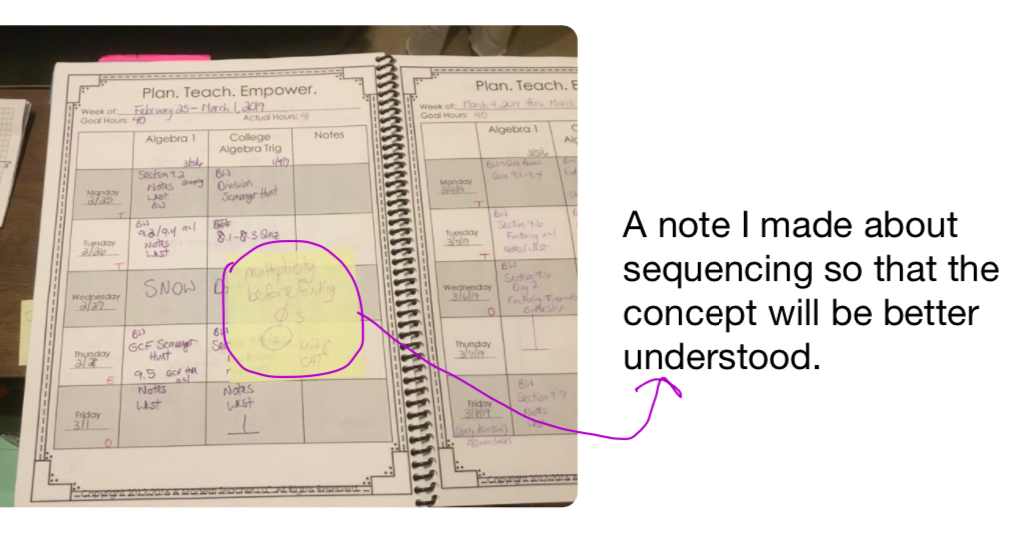
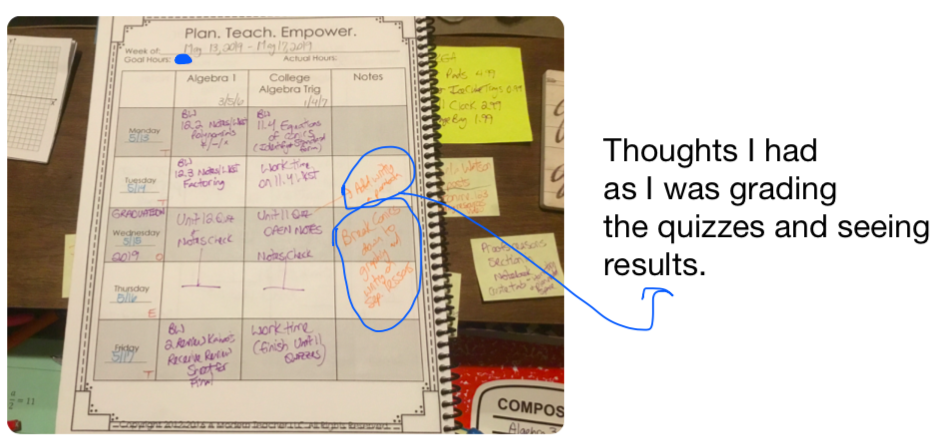
My journey to prove my teaching ability was a success in more ways than one. I earned my Adolescent and Young Adult Mathematics National Board Certification in December of 2017. As I have moved forward with that really exciting accomplishment, I realize that I gained so much more out of the experience in terms of how I run my classroom. I am now in the daily habit of reflecting over my lessons and their results. I designed my own planner pages so that I could keep notes of what I needed to change for the next year. I took note of student reactions and learned to better read body language to tell the difference between the quiet kids who understands and the ones who just act like they understand. My journey to National Board Certification has made me more of a reflective teacher and I couldn’t be happier.

Becoming focused on my daily reflections has helped me really look at what’s best for my students. The job of teaching is really about working with kids and doing what is best for them while trying to teach them content along the way. If we as teachers come to the point where we are simply reusing everything year to year, are we really meeting the needs of our students? If we as teachers continue doing the same lessons and same activities every year, are we serving our students’ needs or our own? There is nothing wrong with reusing items from year to year, but does it hurt anything to simply look them over with our current students in mind? Does it really hurt anything to make a small change or adjustment that will make things better? Trust me, investing your time in this way has huge pay-offs.

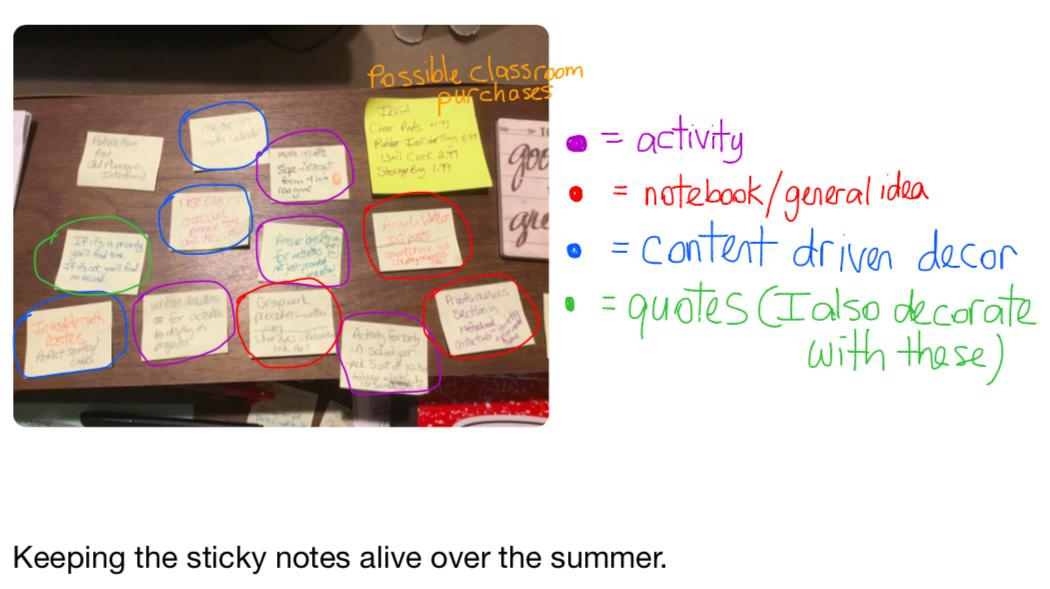
There are so many easy ways to bring self-reflection into your daily teaching practice.  I mentioned my self-designed planner that gives me an automatic thinking space each day for a quick note. I have plastered the space behind my classroom desk with sticky notes of things to change in upcoming lessons based on that year’s student needs. I have started a running word document to track how engaging my activities really are and what I can do to increase the accountability level or changes I need to make to increase the enjoyment. I have taken note of student opinions feedback and let this drive changes that are student centered and beneficial.

If we as dedicated teachers truly look at what goes on in our classrooms from August to June, can each of us say that everything we do is in the best interest of our students and leads to learning? How many of us encourage our students to do self-reflections? Shouldn’t we lead the way by building this into our daily routines? I know teaching is extremely busy, busy, busy. My family lives it right along with me from August to June. I have noticed that my engagement has increased over the last couple of years when I have taken the time to make the changes I noted during a lesson or activity. I have had a few more students struggle a little less with some challenging topics such as factoring and solving quadratic equations by taking note of the exact places of struggle and finding ways to offer a different explanation or find just one more example to help solidify the steps. These are just a couple of the many pay-offs that self-reflection has brought to me, my teaching practice and my students.

We as teachers are a busy and dedicated group of professionals. I promise the daily practice of self-reflection is a worthwhile use of our time. I am continuing with daily reflection this coming year and am looking at new ideas to streamline the process and make it personally effective. I plan to categore my observations into groups so that so that I address things in groups, such as teaching strategies, or on an individual basis, like one of my many activities.

It took the three-year journey of National Board Certification to understand what self-reflection means to me and my students. I can honestly say that I am glad for this change and cannot imagine not working to improve my craft using the help of my own observations. When we take the time to critically look at what we are doing, we will make changes for the better each and every time. Self- reflection is a powerful teaching tool and I hope that more teachers join me in this game-changing practice.

Posted in Teaching Thoughts

I LOVE TEACHING

There are two things that I truly love to do in this world besides spending time with my wonderful and amazingly large family (when you add in all my brothers, sister, nieces, nephews etc). I love to bake desserts of just about any kind, and I love to teach. I don’t love teaching in the sense that it’s my chosen career, so I need to put my very best forward every day. I don’t love teaching in the sense that it’s my chosen career and I do sincerely enjoy it year after year. I mean that I LOVE teaching. I am that teacher who can’t help but shop the clearance sections year-round for deals on school supplies. (Trust me, they pop up at random times and my sons are always rolling their eyes at me.) I am the teacher who has well over 3,000 separate teaching ideas saved to her Pinterest account out of a total of 5100 saved ideas. I am the teacher who knew in kindergarten that she was meant to be a teacher and I followed that dream. I am the teacher who enjoys learning and has a career that needs me to do so on a continuous basis. Simply put, I LOVE teaching.

I started thinking about just how much I love teaching last week as I read the first part of Teach Like A Pirate by Dave Burgess. I felt as though his words were truly speaking to me. He writes about the difference between enthusiasm for something and having true passion for it. His words got me thinking about my true feeling about teaching, and the other main interest I have in my life. (Besides my amazing family of course – they are a category all on their own.) He goes on to explain the different kinds of passion within a career and how they all work together to create an effective person. (I won’t spoil anymore of it for those of you who want to read this fabulous book.) Dave Burgess’ words showed me that teaching really is my true passion.

I know that I really like to bake. I find real happiness in making treats that others can enjoy. I spend quite a bit of time over breaks searching for new dessert and bread recipes. I always have my kitchen stocked with the ingredients to make chocolate chip or peanut butter cookies at a moment’s notice. Baking cookies is relaxing to me, and I spend the first several days of my winter break every year making cookies and other treats to mail out and share with several people. As I was reading Teach Like a Pirate, I began to think about whether or not I have personal passion for this hobby of mine. I realized that while I do truly love baking, I wouldn’t say I am passionate about it; at least not the same way I am about my teaching practice. If I don’t get to my plans to bake over the course of a weekend, I don’t feel as though I have left something unfinished. I don’t feel as though I have missed out on anything. The baked goods would have been nice but going without sweet treats isn’t going to hurt anything.

As much as I promise that I do enjoy my weekends and breaks from my teaching job (I get to hang with my two boys and hubby), I have to admit that I spend a lot of time trying to improve my craft. I feel like I need to be looking for ways to do a better job at reaching all learners, especially my high achieving learners. I am always on the lookout for a new activity, strategy or even classroom decoration. I believe that when I am feeling effective and prepared, my students are receiving the best of me and have a chance to really learn what I am teaching them.

Less important ways that I know teaching is important to me include how I set up my space. I have a huge collection of pens so that I can pick a grading color based on whatever I want. (Seriously, I probably have way too many pens.) I color code my lesson plan book and my grade book and think about ways I can make my classroom an inviting and ultra-organized place. Many, many students have expressed how much they enjoy the way my classroom is happily decorated. All of these little things do scream enthusiasm for the job, but as I learned during this past spring semester, my feelings about my teaching go much deeper than even I expected.

I lost count of the number of times I started class with the excited words “Guess what? I found a new activity for us to do!” It wasn’t just me trying to pep up my students, I was sincerely excited to join in on the ‘fun’ that I had prepared. Nothing gets me fired up quite like a hands-on math activity that will help my students have fun while learning math.  My students were able to quote me on this phrase long before the end of the 1st quarter of school was completed.

I spent hours and hours over the course of the last year reading books, articles, tweets and blogger posts searching for anything magical that I could take back to my kids – yes, my students are also ‘my kids’. I truly want each student in my room to find success with a subject that most of them hate, math, and to do this I need to be a learner myself. 

The very biggest reason that I know I am passionate about teaching is how much I missed it and my kids when I had to turn things over to my student teacher this past spring semester. Luckily, I was assigned a super competent and wonderful student teacher whom my students liked a lot. And sure, I got to spend hours and hours prepping activities, creating a colorfully themed bulletin board and looking at curriculum for the coming school year while he taught my classes and graded the papers. It was awesome to end the school year with a feeling of being a tiny bit prepared for the coming school year. In the end though, I missed my kids. I missed listening to them groan when I reminded them why I want them to show their math work. I missed the guilty looks when homework wasn’t completed. I missed the complaining about math being too hard and boring. I missed the looks of joy when a student who struggles had their lightbulb moment with a new concept. I missed the students rushing into my room to share things about their day with me. I missed working math problems with my students and explaining ways to make them easier. I missed answering homework questions and helping to ease confusion. I missed planning my units. I just missed my job – even though I do enjoy working with future teachers. 

Teaching is in my blood. Teaching is an essential part of me. Teaching is what I do and who I am. Even on my bad days, I know my students are seeing a happy Mrs. Bledsoe – because they tell me this all the time!! “Why are you always so happy?” “How can you love this job so much?” My enthusiasm and passion for my job cannot be faked. I love helping my students learn math. I love working with my students and seeing them grow. Teaching is a huge and essential part of my life. I can’t imagine doing anything else. Simply put, teaching is my passion and I LOVE teaching.