I had the privilege and honor of completing my doctorate last month (May 2025) and with the end of that journey comes relief, joy and time back into my life. I say it was a privilege and honor because I was pushed hard to conduct solid research, and I have a wonderful small book as the result of those tears and hours of reading and writing. So now, what is my next step?
I earned my educational doctorate in curriculum and instruction because I really like teaching. I LOVE teaching and learning. Learning is an essential part of my life, and I look to grow in all that I do. I reached the point in my professional life that a terminal degree made sense. I carefully chose my path to match what I really enjoy, teaching and learning how to be a better teacher.
During my studies, learning about the multiple types of curriculum that currently exist and have existed was so interesting and helped me to pay better attention to what content I was teaching my students. Learning about multiple types of instructional families and all of the methods within those families was useful to helping to keep my teaching fresh and engaging. Teaching is in my bones and is a very important part of who I have become over the last 23 years. I dare to say that it is my calling; other than being a mom to my two most awesome sons.
I now have the academic credentials to coincide with my years of teaching experience, and I feel like I have a lot to share with the education world. I have designed curriculum, activities, and instructional tools for use in my classroom, as well as presentations about how to teach using differentiation. I have read countless books, written papers and posts about current topics in the world of education.
I know that I want to make a measurable difference with all of my knowledge and skills in the classroom as I believe that the role of a teacher is invaluable to those in school. I want to work with other teachers to keep their passion for teaching ignited and burning. Keeping teachers coming back for more years and more students is critical to keep our nation progressing and achieving. We have to pay better attention to our veteran teachers as they have knowledge and skills that are irreplaceable to our educational systems.
We are once again at a critical moment in public education where the powers that be in our legislatures have more control over our schools than we can possibly understand. We need to invest in them and our students. Schools are the place where kids can learn so many skills, types of information and how to forge their own path in the world. If we as a nation stand back and think about the teachers we had in our K-12 years of school, there are going to be wonderful souls that we remember for the positive impact on our lives.
So what do I do now that I am Dr. Heather M Bledsoe? Where do I go from here? I will be teaching students ‘favorite’ subject of mathematics this coming school year in the school I have been at for most of my teaching career. I am excited to be able to ‘just teach’ this year with fewer outside obligations. I hope to have the time to create some of the structures and activities that I have put on the back burner for so long; things I think will really help with my classroom’s culture and success.
I hope to write and design the work and structures I need to share my skills with other teachers. I spent the last three years on my dissertation to earn my doctorate, and that research showed me that there is so much that still needs to be improved so that every student can have a positive school experience, especially with mathematics.
I may not know exactly where my journey is headed, but with an open-mind and heart, I hope to help many other teachers and students to find their passion for learning and teaching. If I can help some students learn how great math is along the way than that is bonus. I guess I need to say………. Watch out world, because here I come.
I finished my 20th year of teaching this May (2022), and I can honestly say it was the hardest year in my entire career. Even my first year of teaching was not as hard as this past year was for me and many, many others. I see stories about teachers leaving the field in large numbers, and I cannot say I am surprised.
I started out the 2021-2022 school year full of hope and anticipation. My district required masks on at all times, but after a year of remote, hybrid and then in-person learning, I was glad to start the year with my students. The only trouble was, there were still too many outside ‘things’ interferring with my teaching. The kids had missed out on time in the building and with groups of people, and even by the end of the year, we were not back to a place where things were normal.
Cell Phone problems were at an all time high. Students COULD NOT and WOULD NOT put them away. It was so ridiculous to look out across my classroom and see students on their phones rather than paying attention or even participating in an activity. The past school year, in the different modes, seemed to increase students’ dependency on their devices. To take the phone was to cause a huge and disruptive scene in class, and after a few of these, I decided to focus on the students paying attention.
Disrespect was at an all time high. I have never had so many students be selfish, rude, mean and even malicious before this year. It was as if students forgot basic common courtesy. I am not one of those teachers who expects respect because I am the teacher, even though I was taught to be respectful to adults as I was growing up. I give respect to my students from day one, in order to build a good working dynamic in my classroom. I work hard to create a classroom environment where students feel comfortable working together and asking for help. It starts with mutual respect, and there was none of that this past school year. I was just another person, who was making students do things they didn’t want to do – unless something was needed.
Apathy. Did students decide that school wasn’t important because they had completed so much time in a remote setting? Did students decide that school wasn’t important because they developed a false sense of security when they had the power to Google all of their assignment answers? There are so many other things that I can add to this list, but the remote/hybrid/in-person year led to an increase in students using their ‘resources’ to complete their work instead of trying to learn the material. This year, I knew to expect some of this, but the level of apathy that was prevalent across my classes was at an all time high. It was as if being in person was a chore, rather than any kind of opportunity to really learn. No willingness to try. No desire to learn new concepts. No desire to complete anything.
There were so many other things that made this school year so much harder, but the three above were the biggest ones. Many, who do not teach and never have taught, want to provide responses like “Well, you are the teacher, just handle it.” or “Well, kids are behind because of the pandemic.” or even “If you are so unhappy, just find a new job.”
The issue isn’t that many teachers had a hard school year, which we all did. The issue is that we are dealing with issues beyond our control, with no real help or support in sight. Schools are the backbone of a functionig society. Education is a life-changing thing to have. I believe in our schools. But when students come to school so behind in social skills, the job is that much tougher. I teach at the high school level, where there are social skills to teach, but usally not on such a large scale. Just because schools were ‘open’ again, people expected things to magically get better – but there was no support. Teachers cannot do their work alone – we need parental/guardian help!
My sincerest hope is that students will take a look at how this school year was for them, and decide to make next year better. That sounds like such an unrealistic dream, but at this point, I am praying for a miracle.
“Know your limits, but never stop trying to exceed them.” This was the quote that my Chrome browser greeted me with today when I logged on to check my email for the day. This quote speaks to the work I am trying to do now, to better myself as a person and an educator. This work pertains to being better equipped to help my students when the school year begins in August.
Over the last few weeks, the racial tensions in this country have reached a breaking point due to horrible and preventable events- and I am glad to see how many are speaking out and protesting against these latest injustices. Work needs to be done to change the state of things. So many people are saying this, but more work needs to be done. It is just crazy to have to say that these are the latest occurances of racial violence, but things have NEVER significantly improved in this country with regards to racial issues. More has to happen than simply stating you stand with people of color – those of us with the privledge of being white need to actuallystand with people of color.
Last Friday, June 12, 2020, I went to a peaceful demonstration “Social Justice March for K-12 Educators”. Dr. Janet Carter and Kim Urenda, a teacher and counselor at one of the high schools in my school district, set up this event where several speakers shared their thoughts and pain over the current state of race affairs in our country. After several thought provoking and moving speeches, we stood along 95th street near Westridge Middle School proudly showing our signs stating things such as ‘Teachers Know Black Lives Matter’ and ‘End Racism Now’. We received mostly happy reactions, but a few decided to flip us off and one person decided to shout a horrible thing out the window. These negative reactions to signs being held quietly and peacefully held up by a shopping mall demonstrate how unfair thing are for so many people. The work must continue.
A key phrase a district administrator for the school district where I work stated to us in the crowd that people of color do not need allies – they need accomplices in their fight for equity and equality. Dr. Tyrone Bates Jr is the Coordinator of Diversity, Equity, and Inclusion for the Shawnee Mission School District; I wish that I would have remembered more that just the statement he made above. This one phrase has helped me to reshape my thoughts on being an educator of young people of color. I need to do more than stopping issues that arise in my classroom, though that is important, and work with my students to see how damaging words can be.
Too often in the past I have kept all topics not related to my mathematics curriculum away from my room. I was worried about the strong opinions that differ within each class and worried about fights between students. Rather than shy away and hide when topics come up that need a discussion to clear up misinformation and allow for a teachable moment, I need to take these opportunities to help right the wrongs that exist. I need to be a teacher that protects all of her students with more than just stopping words and actions. Stoppings the wrongs is a start, but correcting them to prevent future occurances is even better.
I have thought in the past that as a white woman I had no business speaking out on issues of race. It was the safe limit I set for myself, not even realizing as I did so that I was remaining a part of the problem. I don’t want to be a part of the problem – I know and love too many people of color to not do more. I teach students and I can have a positive impact on them through my words, actions and teachings. The hate, inequity and oppression have to stop and as Dr. Bates said, accomplices are needed to complete this important work.
You may be asking what I plan to do to better inform myself on racial issues and how to work to change them. I have been reaching out on social media to find different resources to read, listen to and study. It’s a tiny first step, but I know that with dedicated learning I will be better equipped to have honest conversations when we return to school in the fall. Students will ask my thoughts, and I want to be prepared with more than a couple lines about how horrible these deaths are. My students will know I think they are horrible events, but as high schoolers, they want to know more. They deserve to know more.
A podcast episode I listened to the other day by Angela Watson from 5 years ago still held a relevant message. We are preparing our students to live in this current world and we cannot do that by staying silent. As educators, we have an obligation to stand up for our students because frankly, so few people do. We need to teach our students that all people have the right to fair and equitable treatment. We need to show them how wrong so many aspects of our society are in this current state. I know people worry about teachers pressing their own opinions on students, but these issues are not opinions. These issues are about the factual systemic racism in our country and we must to be brave enough to face them head on. No mother and father should have to coach their children on how to behave around the police. White parents don’t even think about doing this and neither should anyone else feel compelled to protect their children in this way.
Dr. Janet Carter started the speeches at the march with the words “We can do better.” We as educators can and must do better. Our students lives depend upon it, whether they are students of color or not. I hope many of my fellow educators will join my personal work this summer and educate themselves about racial issues. We need to be ready for school in the fall and this work of self-educating would be an important first step in that direction.
Note: Check out Angela Watson’s Truth for Teachers Podcast. All topics are relevant, no matter how long ago she recorded them. Her podcast episodes get right to the heart of all of the relevant issues for teaachers.
If you were to take a look at the curriculum maps for any mathematics subject at the secondary level for my school district, or any school other district, you will notice 10 – 12 neat little units outlined within a pacing guide to fit precisely within the allotted weeks for the school year. You will see objectives for each unit, vocabulary students should know, as well as priority standards highlighted as the must know concepts for each course. Many districts are even moving so far as to create proficiency scales and proficiency tests to keep track of how well students are mastering the priority concepts.
I am in full favor of curriculum maps, as without them people seem to think they are allowed to interpret what material makes it into their teaching and what material is left out. This is often times based on the teacher’s likes, dislikes and view of what their current students will be able to handle. Curriculum should have teacher input but shouldn’t be that open to interpretation. I believe that curriculum maps help to ensure that every student in a particular course receives the same instructional topics no matter what school they are attending within a school district. I personally am excited to see the data from the proficiency scale tests of my students so that I can better help them reach mastery level on the priority standards as well as reflect on my own teaching of these priority concepts. Proficiency scale data used correctly can strengthen a course as well as student achievement.
When the curriculum maps were first created it was to ensure that all of the standards for a course could be taught within a school year. We have always had lists of standards and objectives, but they weren’t always organized. Plus, we had to make sure that our courses aligned with the state standards. During the creation process, time needed to teach topics was looked at as well as what standards appeared in more than one mathematics course. Once everything was settled pacing guides were created to keep instruction consistent across the district. I agree with keeping the instructional pace moving to ensure that too much time isn’t spent on one unit or concept. It can be much too easy to spend time on a favorite topic, thus causing other units to get shortchanged in both time and emphasis. Keeping a pacing guide in mind can keep your instruction focused on what students really need to know and help you emphasize those priority standards.
What you will not see in any of these neat colored-coded standards aligned curriculum maps is review and reteaching time. The objective of the curriculum map is to plan out all of the standards that will fit within a course within a given school year. Time is allowed for the week of finals, but nothing else. This fast-paced schedule of teaching works for the high-achievers who are able to take in lots of information with little need to practice it in order to retain it. Most students are not built this way – in fact the fast-paced schedule allows students to think they know something because they have ‘seen it’ regardless of how well the material is actually mastered.
Proficiency scales built around priority standards are supposed to help with ensuring that students are able to master the big ideas from a course. What students really need to master the material is the time to truly learn the material. It takes several encounters with a topic for most students to even begin to reach the first levels of mastery. Students have to have processing time, time to make mistakes and then time to correct those mistakes. Students have to have time to learn – which is often not accounted for in instructional pacing.
Instructional pacing has not really changed much over the course of time; at least in mathematics. If you look at mathematics textbooks from past decades compared to more recent editions, they all have around 11 or 12 chapters with a stringent built-in pacing guide. The curriculum maps seem to mirror these pacing guides from years ago. Eleven or twelve chapters or units is quite a bit of material to be taught in a school year, let alone absorbed. It is shocking to me that we are still stuck in this antiquated system given how much is known about how the brain works and how students learn.
Students are not little machines that remember everything they see the first time, and this is how education has existed and how it continues to exist. Students need the time to process their learning and practice with the material. Students need time to embrace their mistakes and see them for the learning tool that they can be. Our current pacing doesn’t appear to allow mistakes to be a part of the learning process. We teach a lesson, give homework and repeat this the next day. If a student gets behind or struggles one day then they will have less of a chance of learning everything in the curriculum map because inevitably frustration will set in and take over.
How can teachers help their students have the time they need to master a concept? We need to build cyclical and intentional review into our units. We need to revisit concepts repeatedly and directly throughout the unit. We need to be intentional with our planning to make sure all students have ample time to learn what we need them to.
A colleague of mine teaches in a manner that builds continuous review into every lesson and every test. At first I was hesitant to try this method as it is much different than I am used to teaching and much different than I was taught. The need for my students to show more proficiency has me contemplating why more of us don’t teach this way. She teaches a small piece of a new concept each class and continues to review older ideas each class as well. She still meets all of her curricular objectives for each unit and while it might look like it takes longer, she ends up in the same place that the rest of us do at the end of the semester. She structures her course so that students have ample time to practice mathematical concepts and ample time to correct mistakes that happen as they are learning. It is a huge change in mindset, but one that I am hoping to implement more into my teaching practice.
I have started to revise my teaching process to allow for more review with my students and I am loving the results. I had numerous students score quite well on their semester finals – more than in past years! I have continued to expand my activities and change up my questioning approaches, but the number one thing I can credit this success of my students to is the better job I have done with building review into my class structure. My bellwork exercises have been more intentional with reviewing troublesome ideas from each lesson throughout the unit. I have started putting problems from previous sections at the end of each worksheet – while still keeping the problem number to below twenty. It does a student no good to receive twenty problems over new material when they are still trying to understand the lesson. Also, they need to practice the new material multiple times over multiple days and one set of practice problems is not enough to accomplish this learning need.
My students are receiving fewer new problems and more review over other concepts in a unit and they are finding this a better approach to learning. They are able to ask questions on the material over the course of several days instead of once right after a lesson and then once before the test. They have even told me that while they still don’t like the idea of homework, it doesn’t seem quite as daunting as they can practice an idea many times before a test or quiz.
The struggle for me is to now is to ensure that I stay on track to complete all of my curricular objectives. At times this seems absolutely daunting as there are so many things to teach and not nearly enough time. In math, we can’t simply skip concepts as this is truly a subject area that builds upon itself. I really want to be able to spend the time each student needs to learn the material, but this is not a possibility as I really do have to make sure all the standards are taught. To miss a standard completely would be an even bigger disservice to my students.
For now, I will continue working on increasing the cyclical nature of review. It is taking a lot of thought readjustment and extra time revising perfecting good assignments, but I am keeping my fingers crossed that the longer I explore and expand my cyclical review methods, the more they will become like second nature. My students are doing better and at the end of the day, their success is what is most important.
The
start of every school year is an annual new beginning for me; even more so than
January 1st. My teacher mind runs on a schedule surrounding dates
and activities both at home and at school from August to July; not January to
December. In August, I start figuring out how to put into place the new plans and
ideas that I have worked on during the months of June and July. Given that the
school year is a non-stop progression of teaching, grading and all the millions
of other things teachers do on a daily basis, June and July are the time I
really have to research a better instructional method or just simply create new
activities. Some people don’t understand why I work during those months, but it
is a choice. I choose to work through those two months even though it is summer
break because it is when I have time to rework lessons that didn’t go well and
plan for new activities. I love looking at curriculum and instruction items and
the necessary job of grading stands in the way, as it should, during the school
year.
As
I said before, once August hits, the pace of life picks up at lightning speed. It
picks up even more so when the students arrive about a week after the teachers
do. Each new school year means teaching and refining routines and procedures
with my new students. Each new school year means new strategies to try to make
the learning easier as well as new activities and games to participate in with
my students. I meet my 6 classes of new students with a renewed and fresh
feeling of energy gained from preparing and working at a slower pace over the
summer. I am always excited to meet my new students; to get to know about them
as people and begin working with them on our journey to learn mathematics for
the year.
Just like with New Year’s
resolutions in January, sometimes my good intentions and resolutions fall apart
after the students arrive. It’s never intentional, but old routines that have
been mostly successful can be easy to slip back into play because it’s what my
mind knows. Did I mention this is year 18 for me? I have loved every year of
teaching, but this has proven to be a lot of years to overcome when I try and
change a routine. I don’t necessarily believe I am doing anything in my
classroom that is horribly outdated or boring, but I do want to keep things new
and fresh, both for the students and myself. While my old routines are great
and do lead to student learning, I always strive to do better.
When it comes to working on keeping
resolutions I am unfortunately a ‘bit’ of a perfectionist. My mind seems to have
started working on an all or nothing mindset when it comes to myself and what I
want to do. As I have built reflection into my teaching practice, I have really
come to see how this is keeping me from being who I want to be with my
students. Now, before you say that I am probably being too hard on myself, I
want you to know that I know I do most things right with my students. I know I build
a great classroom atmosphere and solid working relationships with them. I have
had several former students stop in and visit this year and one even draws me
pictures on a daily basis on my whiteboard.
The other thing I have to remember
when my “resolutions” don’t go the way I had hoped is that I teach young
adults. Young adults still have developing minds paired with LOTS of hormonal
changes. My success with a lesson is not entirely dependent upon how well I am
presenting the material, but on how well the lesson is received. Some days are great,
and the students are focused and so much learning happens! Other days, students
are focused on an upcoming school event, troubles with friends or anything else
that has nothing to do with my lesson. I teach young adults and working with
people, especially young people, is never predictable.
My two big resolutions for this
school year were to build brain breaks into my lessons and keep on top of
grading better. The second item I have a bit more control over, so I don’t
really want to discuss how I still have trouble keeping up with grading after
all my years of teaching experience. As far as my first resolution goes, the
one thing that did surprise me about trying brain breaks is how quickly they
unraveled. One would think I could control the brain breaks as just another
quick activity in class– but I was proven wrong. My students, even the juniors
and seniors, have proven over and over that they have difficulty refocusing
after we stop for even a moment with the material. They try and sneak out their
phones (a whole separate issue) or they just space out instead of doing the
speaking prompts or quick stretching movements I have tried. Then, there is
simply the squirrely behavior of some of my freshmen students this year. I
cannot count the number of times that I have said ‘Glue sticks are not Chap
Stick.’ It’s hard to do anything but keep working problems in a structured
setting while you make sure nothing too crazy happens. I am not giving up on
this idea by any means, but I need to flush out what I have tried in order to remake
brain breaks into a workable part of my classroom structure.
At
an in-service session I went to before the start of school, two wonderful
speakers discussed the idea of planning who you want to BE during the school
year rather than what you want to DO during the school year. (Thanks to Dre
Carnegie and Libby Kramer for that inspiring thought.) Habitually, I have focused
on what I want to do during a school year in terms of keeping organized,
planning new activities and new ways to help student engagement. This year my
list of things to do wasn’t working out at all and I luckily came to the
realization about four weeks into the school year that I was spinning my wheels
and frustrated. I realized I was focusing on accomplishing “things” and I
wasn’t connecting with my students the way I always do. This led to my unsatisfied and frustrated feelings,
which left me drained of energy and struggling to keep up with everything.
A couple of weeks ago, I decided
to refocus my energy on simply being present with my students. This has become a way to help them keep
engaged in the lesson instead of just taking 60 seconds to here or there in a
lesson to process what we just discussed. I started to focus on who I want to
be as a teacher, instead of looking at how my resolutions – my things to do –
hadn’t worked out. Being ‘present’ is what I tried to work on last school year,
and the ever-growing pile of work and emails and other commitments just weighed
me down. It’s not as if I ever ignored my students or didn’t immediately answer
questions, but if they were supposed to be working on an assignment for more
than a five-minute stretch, back to my desk I went to try and get something
crossed off of the to-do list. Once I sat down, the students would think that I
wasn’t paying attention and stop working – thus taking their work time to cause
distractions instead of using it wisely. It was a losing battle that I tried to
manage only to end up spending all of my time discussing behavior issues with
my students.
This
year, as part of my new goal to really focus on keeping my students engaged, I
have decided to join the standing desk trend. I already have my rows of desks
neatly divided into two sections so that I can reach more students quickly when
help is needed This arrangement has allowed me to set up a station in between
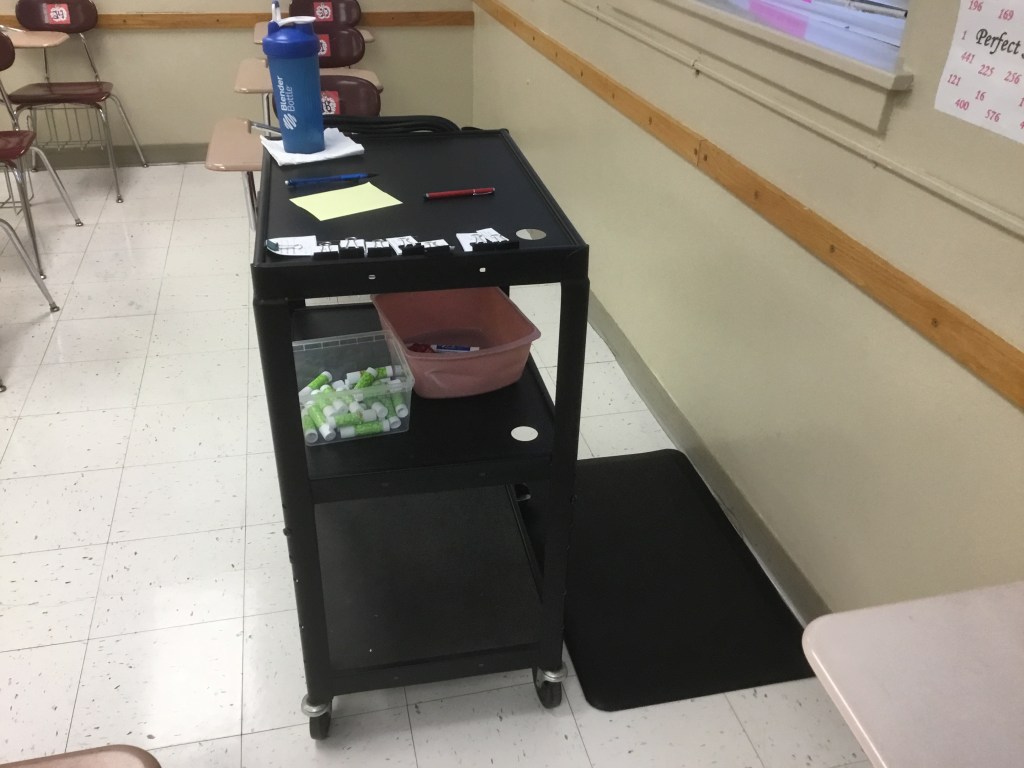
them easily. Throw in my old overhead projector cart and an awesome cushiony
mat my family gifted me with and I am ready to roll. Just being out from behind
my desk and in and amongst my students has made a world of a difference. Now,
my feet and back have feelings about my new station, but that is an unimportant
story as this seemingly small change has really benefitted not only my
students, but myself as well. I feel more connected to my students because I
can see nearly everything that they do. I can see when they need help and just
don’t want to admit it. I can see when they try and sneak time on their cellphones
or distract a classmate and I can get to them faster when they are brave enough
to ask for help. Despite my sore and hurting feet – even with the cushiony mat
– I am loving how I have changed up my routine. I will not go back to
stationing myself behind my desk during work time in class. (For days when I
just cannot stand anymore – I found a stool to assist me. J)
I
am a person who thrives on finishing a to-do list – at least I normally am.
This school year has changed that part of my routine and my thinking. I don’t
want to just cross stuff off of a list, I want to be a ‘focused on my students’
teacher. Once I started focusing on being fully present with my students and
really watching for their progress with the material we are working on,
everything else just fell into place. More work was being done by them and I
was feeling energized at the end of the teaching day! Simply keeping myself
physically closer to my students and avoiding the trap of my desk has allowed
me to connect with my students so much better. They no longer hesitate to ask a
question since they can get my attention easier. As I can see nearly everything
they are doing I am able to keep more kids on track. I have even been able to
help some of my more energetic students focus a little better by sitting them
next to me and my cart.
I
am back to better utilizing a daily to do list because of this reenergized
feeling I have every day– not to keep busy, but because I don’t want to forget
to do stuff. I teach young adults – and
sometimes they need some guidance and attention, which can lead to me
forgetting to do the simple things, like answer emails and run copies. The
feelings of being energized at the end of the day are still there – and this is
the second week of the standing desk. It’s like the missing pieces of this
school year have finally fallen into place and we are rocking and rolling
through our content – and I am starting to catch back up with all of the
millions of teacher things I have to do each day. I only wish I hadn’t
hesitated so long to change up my personal routine and stay away from my desk
during class work time. Keeping myself physically within my students throughout
the entire class has changed their perspective so that they feel I am near them
all the time. They know I will catch the wrong behaviors and fix the math needs
much quicker than just a few short weeks ago and they are starting to change
their behaviors as well; not all of them, but a few of them.
Working
from a standing desk set-up is a different thing, but not entirely outside of
the norm from what teachers do on a daily basis. Many teachers circulate amongst their
students during the lessons but also return to their desks to get the
never-ending pile of ‘things’ done when students are working. I can’t say that
trying to get work done when students are working is a bad thing. There are
only so many minutes in each day and we have to utilize them to the best of our
ability. I have decided I prefer to focus on my students and becoming the
teacher they need me to be. This is different for each and every one of my
students, but the more I can pay attention to them, the better classes will run
and in the end, the more work I will be able to accomplish during the school
day. There will always be a never-ending supply of papers to grade and lessons
to plan but having a sense of true purpose for my students and keeping myself
energized will help me to complete all of those to-do list items. I don’t want
to be known as a teacher who always finished her to-do lists; I want to be
known as a teacher who makes sure her students learn and grow while in my
classroom.
I routinely work on two non-academic skills, outside of mathematics, with my students during the school year – engagement and motivation. While it seems like these are two skills that a teacher cannot directly control, I have come to understand that teachers have much more power over the engagement and motivation of their students than many of us realize. We think of the engagement and motivation of our students as something that is completely in their control, but this couldn’t be further from the truth. Over the past several weeks, I have been researching and reading about how to increase levels of student engagement and motivation and have learned more about how teachers can help students with their engagement and motivation. Much of what we do on a regular basis within our classroom has a direct effect on our students’ levels of engagement and motivation.
The reason that I focus on engagement and motivation in my classroom is that I teach mathematics – a subject that so many people dislike; when in truth, they have never given it a chance. (I will talk about this in a future post). My job at times seems that much harder because I constantly hear, “I like you Mrs. Bledsoe, I just don’t like math.” For this reason alone, math is a low priority with completing homework and even when making up tests and quizzes. To try and address this problem, I dedicate much of my effort to increasing the engagement and motivation of my students.
In order for students to learn mathematics they have to truly engage with the material while they learn, practice and apply the concepts. Both the practice and application take motivation to complete – especially the application part of mathematics; which is where the true math learning happens! Before that feeling of motivation to work on a problem is possible, decent levels of engagement have to be present within my students so that they are willing to at least take some information into their brains. We all know that if students are not engaged, they are not able to learn what we are trying so very hard to teach them. If a student spends enough time disengaged from class, he or she will find themselves in a world of trouble come assessment time and subsequent engagement motivation will seem lost to us. If even a little of the lesson is understood and remembered, the students have a place to start their work.
Lack of engagement in classroom activities and lessons is an all too frequent problem that teachers of all grades and disciplines across the country work to address every school year. There are always reasons beyond the teacher’s control as to why students might not be academically engaged. Students could be dealing with less than ideal circumstances at home. Students are tired from staying up late for any number of reasons. Students are struggling to learn material or even to attend school. There are however ways teachers can help control the engagement within the class structure. Teachers are the primary driving force behind the routines, activities, presentations and levels of engagement in their classrooms. Students look to their teachers as a guide for how class will run. Will it be a boring class where they sit and attempt to take notes from the beginning to the end? Will it be a class full of movement and activities? When teachers provide an engaging classroom atmosphere and structure, students will have more opportunity to find academic successes. The right atmosphere will help even the most reluctant of learners at least attempt an activity.
Another part of the teacher’s job is to keep the engagement level high and focused. There are times when things happen that completely stop instruction that are out of our control, such as a phone call from the office or a fire drill. We can and must control the transitions in between activities and parts of the lesson as much as we can! Any time perceived as down time on the part of our students causes them to disengage from the lesson. When that happens, we have to spend our time reengaging them instead of continuing with the lesson. Remember in all of our under graduate classes when the professors stressed smooth transitions? When we are being evaluated aren’t transitions always commented on? Turns out these things happen for an extremely important reason – helping us to learn how to better keep students focused on what we want them to be learning. Transitions are something we can all struggle with, but when thinking of them in terms of keeping engagement levels high, they are totally worth our teacher attention and effort.
Motivation can be a harder skill to foster in students. We can have a student who seems fully engaged in the lesson but stops working as soon as it comes time to work independently or in a small group. It’s so much safer to answer questions when the teacher is guiding the lesson, but a whole other thing to produce work independently. Students have to believe that they can accomplish the learning task at hand, or many of them will simply not try. Much of this perceived shut down is due to past frustrations and perceived failures in their learning. In truth, when students avoid completing work it’s because they have changed their motivation from learning to avoiding failure.
Students who have learning successes are more willing to keep reaching for more success. I emphasize this idea in my own classroom all the time, each and every school year. I am of the opinion that success with one learning task will lead to more and more engagement in the classroom activities and learning. I cheer my students on to find this first successful task so that they have a reference point to think about when the next activity pushes them a little more. Humans want to be successful and accomplish goals – be they academic, job related or social related. All it takes is one successful outcome to get the ball rolling and then we can remind them of that success when doubt creeps back in to their minds.
I also discuss with my students the idea of mistakes being a great and expected thing in math class while learning material. Mistakes are where learning truly occurs and are a necessary and vital part of the process. We talk about not focusing on making the mistake itself, but on how this will fix our learning during the correction process. Many students are so worried about making mistakes that they quit working until they can ask more questions. Asking questions is terrific and I love to help my students. At the same time though, I need and want to foster a sense of independence and motivation to at least try work on their own. I work to change the motivation from avoiding mistakes, to not being bothered by them.
Engagement and motivation are two non-academic skills that are crucial for success not just with school, but with life beyond school. We have to show kids that these skills can lead them to so many wonderful and successful opportunities. They just have to be willing to stay engaged with the task at hand and stay motivated to complete it. Engagement and motivation are two skills that can and will lead to great outcomes for each and every one of our students and for each of us as well.
I was at an in-service last week and heard from one of the many terrific presenters that right now is a great time to be a teacher. He went on to explain that currently there are so many books for teachers to read that anyone can find something of interest; something that will give them a new nugget of insight to improve their craft. I immediately agreed with this thought. This time of great thinkers and movers in the education world means anyone can find something of interest to read! Everyone can find a way to improve their craft and make their classrooms a better place for kids!! Of course, as I say this I am reading three different education books in the hopes of finding a new nugget to make the next year better.
Why do I read educational books instead of just looking for strategies or activities? Why do I read books instead of choosing the ever popular Podcast format? One reason is that I LOVE TO READ. I have been an avid reader since I finished my first Laura Ingalls Wilder book in 2nd grade over thirty years ago. Give me a comfy chair and a stack of books and I am a happy girl. Another reason is that I do think that many teachers are readers at heart; after all, how many of us read book after book in our undergrad and graduate degree studies?
I think the issue that many educators face is that they have forgotten how rewarding their own reading can be due to how busy we get during the school year. When faced with a stack of 60 tests to grade for anxiously awaiting students, most teachers will choose the tests over reading something to improve the school year. We have also read so many assigned books in the pursuit of our degrees that many teachers finish their Master’s Degree and declare they need to take a break from reading. Is it really a break from reading they want, or is it a break from being told what to read?
We as teachers need to carve out time to work on our craft. How many times have we all heard the phrase that teachers build life long learners. Shouldn’t we as teachers model that life-long learner attitude? Should we ever reach a point where we feel that our classroom is running just fine and no need for improvement is needed?
Reading education books is a way to hear from other teachers. Teachers by the dozens (maybe more) are writing books about their experiences and the ways that they have improved their teacher practice. There are also books about reconnecting with our love of teaching. Teaching is a HARD job. We are under fire from so many different directions that this career path is not for the faint of heart. With that in mind, shouldn’t we carve out a way to give ourselves some quiet time and maybe make our jobs a little easier by discovering a new ‘nugget’ to make our kids into better learners.
With all of the books that are in publication and all the books that are to come, I hope that many of my fellow teachers can reconnect with their love of reading. Of course it doesn’t have to be simply educational books that are read – we should get to have some fun reading too. I just know that this super-duper busy teacher plans to carve time out for reading in the coming school year that I can justify as work based. It might just ease that conscience of mine when I decide to read instead of finishing the grading on that stack of 60 tests.


 Musing of a Motivated Math Teacher