
The start of every school year is an annual new beginning for me; even more so than January 1st. My teacher mind runs on a schedule surrounding dates and activities both at home and at school from August to July; not January to December. In August, I start figuring out how to put into place the new plans and ideas that I have worked on during the months of June and July. Given that the school year is a non-stop progression of teaching, grading and all the millions of other things teachers do on a daily basis, June and July are the time I really have to research a better instructional method or just simply create new activities. Some people don’t understand why I work during those months, but it is a choice. I choose to work through those two months even though it is summer break because it is when I have time to rework lessons that didn’t go well and plan for new activities. I love looking at curriculum and instruction items and the necessary job of grading stands in the way, as it should, during the school year.
As I said before, once August hits, the pace of life picks up at lightning speed. It picks up even more so when the students arrive about a week after the teachers do. Each new school year means teaching and refining routines and procedures with my new students. Each new school year means new strategies to try to make the learning easier as well as new activities and games to participate in with my students. I meet my 6 classes of new students with a renewed and fresh feeling of energy gained from preparing and working at a slower pace over the summer. I am always excited to meet my new students; to get to know about them as people and begin working with them on our journey to learn mathematics for the year.
Just like with New Year’s resolutions in January, sometimes my good intentions and resolutions fall apart after the students arrive. It’s never intentional, but old routines that have been mostly successful can be easy to slip back into play because it’s what my mind knows. Did I mention this is year 18 for me? I have loved every year of teaching, but this has proven to be a lot of years to overcome when I try and change a routine. I don’t necessarily believe I am doing anything in my classroom that is horribly outdated or boring, but I do want to keep things new and fresh, both for the students and myself. While my old routines are great and do lead to student learning, I always strive to do better.
When it comes to working on keeping resolutions I am unfortunately a ‘bit’ of a perfectionist. My mind seems to have started working on an all or nothing mindset when it comes to myself and what I want to do. As I have built reflection into my teaching practice, I have really come to see how this is keeping me from being who I want to be with my students. Now, before you say that I am probably being too hard on myself, I want you to know that I know I do most things right with my students. I know I build a great classroom atmosphere and solid working relationships with them. I have had several former students stop in and visit this year and one even draws me pictures on a daily basis on my whiteboard.

The other thing I have to remember when my “resolutions” don’t go the way I had hoped is that I teach young adults. Young adults still have developing minds paired with LOTS of hormonal changes. My success with a lesson is not entirely dependent upon how well I am presenting the material, but on how well the lesson is received. Some days are great, and the students are focused and so much learning happens! Other days, students are focused on an upcoming school event, troubles with friends or anything else that has nothing to do with my lesson. I teach young adults and working with people, especially young people, is never predictable.
My two big resolutions for this school year were to build brain breaks into my lessons and keep on top of grading better. The second item I have a bit more control over, so I don’t really want to discuss how I still have trouble keeping up with grading after all my years of teaching experience. As far as my first resolution goes, the one thing that did surprise me about trying brain breaks is how quickly they unraveled. One would think I could control the brain breaks as just another quick activity in class– but I was proven wrong. My students, even the juniors and seniors, have proven over and over that they have difficulty refocusing after we stop for even a moment with the material. They try and sneak out their phones (a whole separate issue) or they just space out instead of doing the speaking prompts or quick stretching movements I have tried. Then, there is simply the squirrely behavior of some of my freshmen students this year. I cannot count the number of times that I have said ‘Glue sticks are not Chap Stick.’ It’s hard to do anything but keep working problems in a structured setting while you make sure nothing too crazy happens. I am not giving up on this idea by any means, but I need to flush out what I have tried in order to remake brain breaks into a workable part of my classroom structure.
At an in-service session I went to before the start of school, two wonderful speakers discussed the idea of planning who you want to BE during the school year rather than what you want to DO during the school year. (Thanks to Dre Carnegie and Libby Kramer for that inspiring thought.) Habitually, I have focused on what I want to do during a school year in terms of keeping organized, planning new activities and new ways to help student engagement. This year my list of things to do wasn’t working out at all and I luckily came to the realization about four weeks into the school year that I was spinning my wheels and frustrated. I realized I was focusing on accomplishing “things” and I wasn’t connecting with my students the way I always do. This led to my unsatisfied and frustrated feelings, which left me drained of energy and struggling to keep up with everything.
A couple of weeks ago, I decided to refocus my energy on simply being present with my students. This has become a way to help them keep engaged in the lesson instead of just taking 60 seconds to here or there in a lesson to process what we just discussed. I started to focus on who I want to be as a teacher, instead of looking at how my resolutions – my things to do – hadn’t worked out. Being ‘present’ is what I tried to work on last school year, and the ever-growing pile of work and emails and other commitments just weighed me down. It’s not as if I ever ignored my students or didn’t immediately answer questions, but if they were supposed to be working on an assignment for more than a five-minute stretch, back to my desk I went to try and get something crossed off of the to-do list. Once I sat down, the students would think that I wasn’t paying attention and stop working – thus taking their work time to cause distractions instead of using it wisely. It was a losing battle that I tried to manage only to end up spending all of my time discussing behavior issues with my students.
This year, as part of my new goal to really focus on keeping my students engaged, I have decided to join the standing desk trend. I already have my rows of desks neatly divided into two sections so that I can reach more students quickly when help is needed This arrangement has allowed me to set up a station in between them easily. Throw in my old overhead projector cart and an awesome cushiony mat my family gifted me with and I am ready to roll. Just being out from behind my desk and in and amongst my students has made a world of a difference. Now, my feet and back have feelings about my new station, but that is an unimportant story as this seemingly small change has really benefitted not only my students, but myself as well. I feel more connected to my students because I can see nearly everything that they do. I can see when they need help and just don’t want to admit it. I can see when they try and sneak time on their cellphones or distract a classmate and I can get to them faster when they are brave enough to ask for help. Despite my sore and hurting feet – even with the cushiony mat – I am loving how I have changed up my routine. I will not go back to stationing myself behind my desk during work time in class. (For days when I just cannot stand anymore – I found a stool to assist me. J)
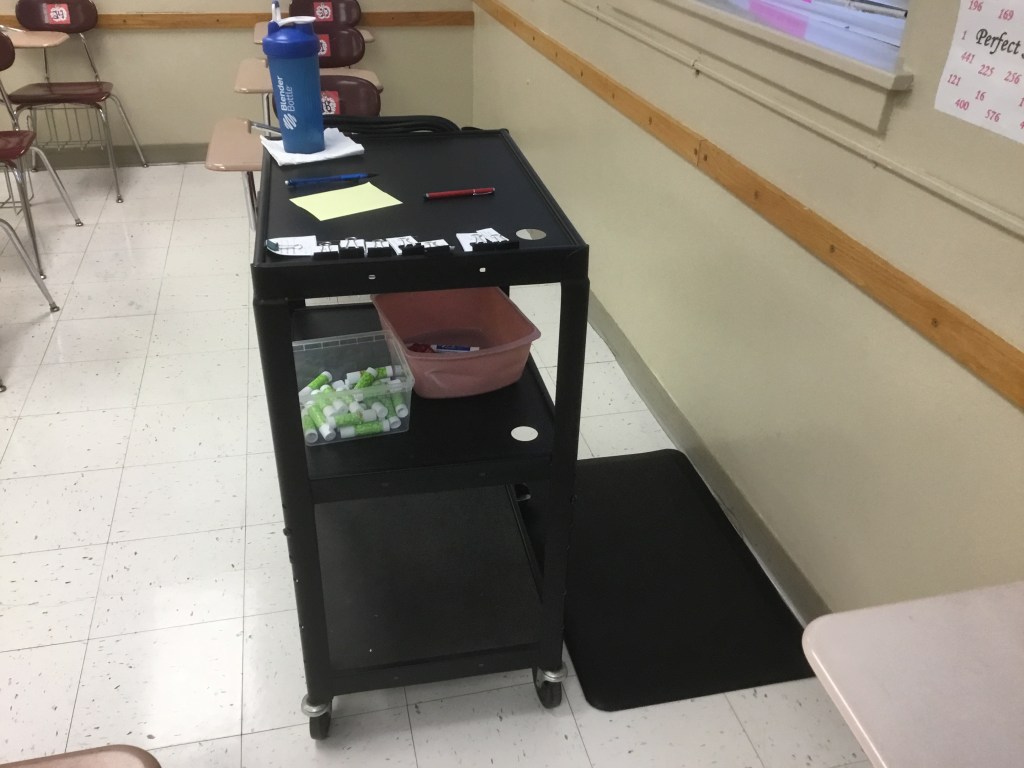
I am a person who thrives on finishing a to-do list – at least I normally am. This school year has changed that part of my routine and my thinking. I don’t want to just cross stuff off of a list, I want to be a ‘focused on my students’ teacher. Once I started focusing on being fully present with my students and really watching for their progress with the material we are working on, everything else just fell into place. More work was being done by them and I was feeling energized at the end of the teaching day! Simply keeping myself physically closer to my students and avoiding the trap of my desk has allowed me to connect with my students so much better. They no longer hesitate to ask a question since they can get my attention easier. As I can see nearly everything they are doing I am able to keep more kids on track. I have even been able to help some of my more energetic students focus a little better by sitting them next to me and my cart.
I am back to better utilizing a daily to do list because of this reenergized feeling I have every day– not to keep busy, but because I don’t want to forget to do stuff. I teach young adults – and sometimes they need some guidance and attention, which can lead to me forgetting to do the simple things, like answer emails and run copies. The feelings of being energized at the end of the day are still there – and this is the second week of the standing desk. It’s like the missing pieces of this school year have finally fallen into place and we are rocking and rolling through our content – and I am starting to catch back up with all of the millions of teacher things I have to do each day. I only wish I hadn’t hesitated so long to change up my personal routine and stay away from my desk during class work time. Keeping myself physically within my students throughout the entire class has changed their perspective so that they feel I am near them all the time. They know I will catch the wrong behaviors and fix the math needs much quicker than just a few short weeks ago and they are starting to change their behaviors as well; not all of them, but a few of them.
Working from a standing desk set-up is a different thing, but not entirely outside of the norm from what teachers do on a daily basis. Many teachers circulate amongst their students during the lessons but also return to their desks to get the never-ending pile of ‘things’ done when students are working. I can’t say that trying to get work done when students are working is a bad thing. There are only so many minutes in each day and we have to utilize them to the best of our ability. I have decided I prefer to focus on my students and becoming the teacher they need me to be. This is different for each and every one of my students, but the more I can pay attention to them, the better classes will run and in the end, the more work I will be able to accomplish during the school day. There will always be a never-ending supply of papers to grade and lessons to plan but having a sense of true purpose for my students and keeping myself energized will help me to complete all of those to-do list items. I don’t want to be known as a teacher who always finished her to-do lists; I want to be known as a teacher who makes sure her students learn and grow while in my classroom.

 Musing of a Motivated Math Teacher