Posted in Math Teacher

Engagement and Motivation – Two Necessary Skills in Academics

I routinely work on two non-academic skills, outside of mathematics, with my students during the school year – engagement and motivation. While it seems like these are two skills that a teacher cannot directly control, I have come to understand that teachers have much more power over the engagement and motivation of their students than many of us realize. We think of the engagement and motivation of our students as something that is completely in their control, but this couldn’t be further from the truth. Over the past several weeks, I have been researching and reading about how to increase levels of student engagement and motivation and have learned more about how teachers can help students with their engagement and motivation. Much of what we do on a regular basis within our classroom has a direct effect on our students’ levels of engagement and motivation.  

The reason that I focus on engagement and motivation in my classroom is that I teach mathematics – a subject that so many people dislike; when in truth, they have never given it a chance. (I will talk about this in a future post). My job at times seems that much harder because I constantly hear, “I like you Mrs. Bledsoe, I just don’t like math.” For this reason alone, math is a low priority with completing homework and even when making up tests and quizzes. To try and address this problem, I dedicate much of my effort to increasing the engagement and motivation of my students.

In order for students to learn mathematics they have to truly engage with the material while they learn, practice and apply the concepts. Both the practice and application take motivation to complete – especially the application part of mathematics; which is where the true math learning happens!  Before that feeling of motivation to work on a problem is possible, decent levels of engagement have to be present within my students so that they are willing to at least take some information into their brains. We all know that if students are not engaged, they are not able to learn what we are trying so very hard to teach them. If a student spends enough time disengaged from class, he or she will find themselves in a world of trouble come assessment time and subsequent engagement motivation will seem lost to us. If even a little of the lesson is understood and remembered, the students have a place to start their work.

Lack of engagement in classroom activities and lessons is an all too frequent problem that teachers of all grades and disciplines across the country work to address every school year. There are always reasons beyond the teacher’s control as to why students might not be academically engaged. Students could be dealing with less than ideal circumstances at home. Students are tired from staying up late for any number of reasons. Students are struggling to learn material or even to attend school. There are however ways teachers can help control the engagement within the class structure. Teachers are the primary driving force behind the routines, activities, presentations and levels of engagement in their classrooms. Students look to their teachers as a guide for how class will run. Will it be a boring class where they sit and attempt to take notes from the beginning to the end? Will it be a class full of movement and activities? When teachers provide an engaging classroom atmosphere and structure, students will have more opportunity to find academic successes. The right atmosphere will help even the most reluctant of learners at least attempt an activity.  

Another part of the teacher’s job is to keep the engagement level high and focused. There are times when things happen that completely stop instruction that are out of our control, such as a phone call from the office or a fire drill. We can and must control the transitions in between activities and parts of the lesson as much as we can! Any time perceived as down time on the part of our students causes them to disengage from the lesson. When that happens, we have to spend our time reengaging them instead of continuing with the lesson. Remember in all of our under graduate classes when the professors stressed smooth transitions? When we are being evaluated aren’t transitions always commented on? Turns out these things happen for an extremely important reason – helping us to learn how to better keep students focused on what we want them to be learning. Transitions are something we can all struggle with, but when thinking of them in terms of keeping engagement levels high, they are totally worth our teacher attention and effort.

Motivation can be a harder skill to foster in students. We can have a student who seems fully engaged in the lesson but stops working as soon as it comes time to work independently or in a small group. It’s so much safer to answer questions when the teacher is guiding the lesson, but a whole other thing to produce work independently. Students have to believe that they can accomplish the learning task at hand, or many of them will simply not try. Much of this perceived shut down is due to past frustrations and perceived failures in their learning. In truth, when students avoid completing work it’s because they have changed their motivation from learning to avoiding failure.

Students who have learning successes are more willing to keep reaching for more success. I emphasize this idea in my own classroom all the time, each and every school year. I am of the opinion that success with one learning task will lead to more and more engagement in the classroom activities and learning. I cheer my students on to find this first successful task so that they have a reference point to think about when the next activity pushes them a little more. Humans want to be successful and accomplish goals – be they academic, job related or social related. All it takes is one successful outcome to get the ball rolling and then we can remind them of that success when doubt creeps back in to their minds.

I also discuss with my students the idea of mistakes being a great and expected thing in math class while learning material. Mistakes are where learning truly occurs and are a necessary and vital part of the process. We talk about not focusing on making the mistake itself, but on how this will fix our learning during the correction process. Many students are so worried about making mistakes that they quit working until they can ask more questions. Asking questions is terrific and I love to help my students. At the same time though, I need and want to foster a sense of independence and motivation to at least try work on their own. I work to change the motivation from avoiding mistakes, to not being bothered by them.

Engagement and motivation are two non-academic skills that are crucial for success not just with school, but with life beyond school. We have to show kids that these skills can lead them to so many wonderful and successful opportunities. They just have to be willing to stay engaged with the task at hand and stay motivated to complete it. Engagement and motivation are two skills that can and will lead to great outcomes for each and every one of our students and for each of us as well.
Posted in Teaching Thoughts

The Need for Reflective Teaching

Teaching is a fast-paced career that is both extremely rewarding and extremely challenging. Daily tasks that must happen outside of teaching time (you know, that 50ish-minute plan time) include creating engaging lessons, grading papers and contacting parents. This is a large amount of important and essential work, but most of a teacher’s day is actually spent teaching students content while building positive relationships with those same students as we work to create a classroom environment that is positive and conducive to learning. This job of teaching is one that requires being adaptable, flexible and present during each and every teaching moment; regardless of all the other work that must be completed.

  Many times, we as teachers feel as if we cannot handle even one more thing to do because many of us are constantly trying to catch up or stay caught up with our work. We work in the evenings; we work on the weekends and we sometimes work in the summers. We do this all for our students and the career we love, but an important piece of the job is missing from the tasks I mentioned. To get to this missing piece of the job I want to explain the journey I took to adding this piece into my daily practice.

I am a person who was taught from a young age to always strive to excel at whatever I am doing. When I was an undergraduate student at Pittsburg State University, I had a professor explain National Board Certification to a group of us aspiring teachers on the way back from a field trip. It isn’t a mandatory certification to receive and many wonderful teachers never seek out this distinction. Earning this certification shows that students learn with you; the true job of a teacher. National Board Certification shows others that you are an accomplished teacher – a master teacher even. Earning this certification means you demonstrated meeting national standards for excellence in teaching. I immediately put National Board Certification on my professional bucket list of things to accomplish before I retired. This dream gave me the goal to work on providing the best learning environment possible for my students while helping them grow in their math skills.

Several years ago, five to be exact, I began my journey to become National Board Certified. I chose to work on my National Board Certification because I believed that I was a pretty good math teacher who had a wonderful classroom environment and was overall successful with helping my students learn math. (There are always the SUPER hard to reach kids, but we will discuss that in a laterpost.) I began my three-year journey thinking I was simply going to prove what I hoped was the case – that I was a really good teacher. I should note that my journey took three years because I began it during the time when the process was under revision and I had no choice in my timeline. I honestly cannot imagine doing it in less time, but that is now an option for new candidates.

What I learned from this three-year journey is that self-reflection is an essential part of our teaching jobs and I don’t think any of us truly do this often enough. A huge part of the National Board Certification process is looking at every aspect of your teaching practice and defending how you know your students are learning. There are video tape components where you analyze the exact moments students are learning the objective of that day. There are written components that analyze your teaching practice in how you differentiate for each student in class. There is a several part written component about your assessment structure and how the results are used to further student learning over the rest of the school year.

Over the course of those three years, I have never looked so deeply into what actually goes on in my classroom. I don’t mean looking at the tests scores students receive or the behavior management that needs to be in place to keep the learning front and center during each lesson. I am talking about looking at how each student is learning and how you know when they fully and truly understand a concept. I am talking about critically looking at how your lessons are structured so that the quiet kids who understand that material right away are learning as much as the quiet and reluctant learners. I am talking about reflecting on how you assess your students and deciding if it is more than just having students demonstrate their knowledge at a basic level. I had to look deeply at everything I was doing as a teacher, what my students were learning and how could I prove that learning was taking place.

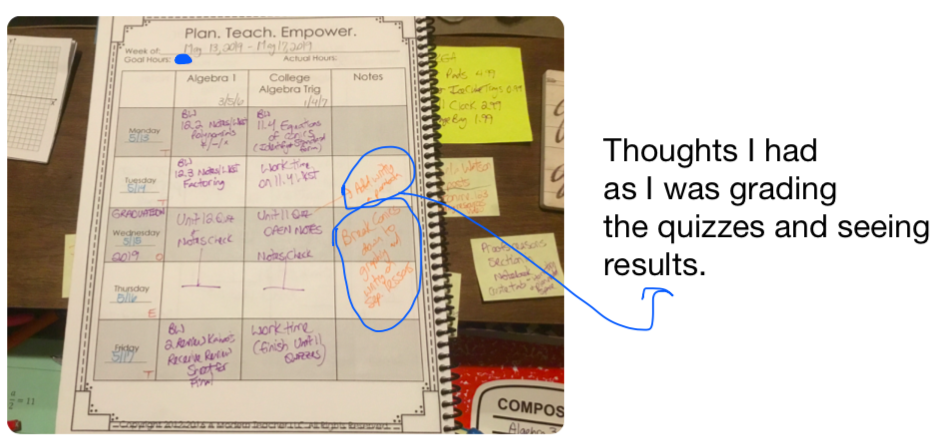
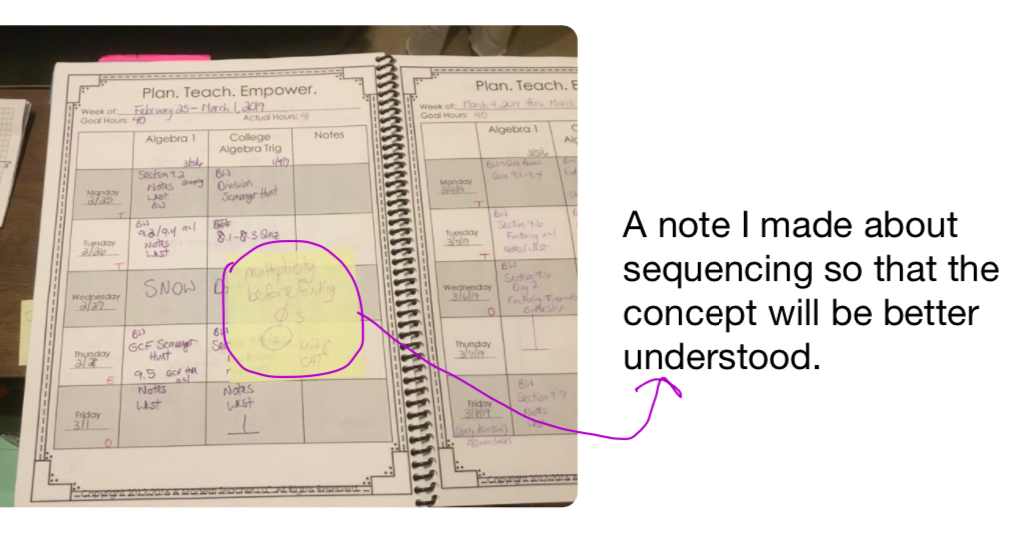
My journey to prove my teaching ability was a success in more ways than one. I earned my Adolescent and Young Adult Mathematics National Board Certification in December of 2017. As I have moved forward with that really exciting accomplishment, I realize that I gained so much more out of the experience in terms of how I run my classroom. I am now in the daily habit of reflecting over my lessons and their results. I designed my own planner pages so that I could keep notes of what I needed to change for the next year. I took note of student reactions and learned to better read body language to tell the difference between the quiet kids who understands and the ones who just act like they understand. My journey to National Board Certification has made me more of a reflective teacher and I couldn’t be happier.

Becoming focused on my daily reflections has helped me really look at what’s best for my students. The job of teaching is really about working with kids and doing what is best for them while trying to teach them content along the way. If we as teachers come to the point where we are simply reusing everything year to year, are we really meeting the needs of our students? If we as teachers continue doing the same lessons and same activities every year, are we serving our students’ needs or our own? There is nothing wrong with reusing items from year to year, but does it hurt anything to simply look them over with our current students in mind? Does it really hurt anything to make a small change or adjustment that will make things better? Trust me, investing your time in this way has huge pay-offs.

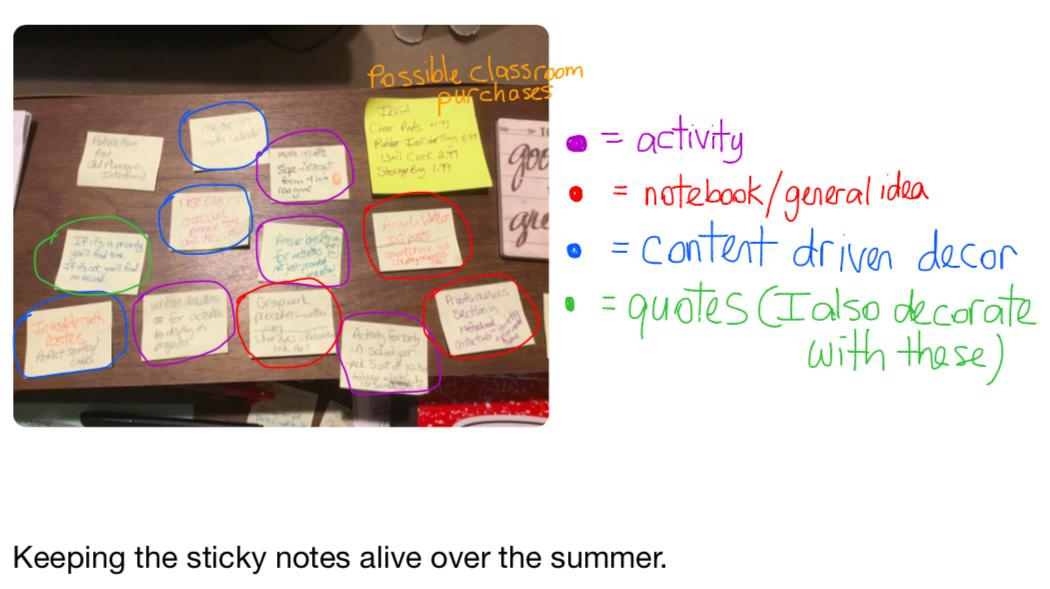
There are so many easy ways to bring self-reflection into your daily teaching practice.  I mentioned my self-designed planner that gives me an automatic thinking space each day for a quick note. I have plastered the space behind my classroom desk with sticky notes of things to change in upcoming lessons based on that year’s student needs. I have started a running word document to track how engaging my activities really are and what I can do to increase the accountability level or changes I need to make to increase the enjoyment. I have taken note of student opinions feedback and let this drive changes that are student centered and beneficial.

If we as dedicated teachers truly look at what goes on in our classrooms from August to June, can each of us say that everything we do is in the best interest of our students and leads to learning? How many of us encourage our students to do self-reflections? Shouldn’t we lead the way by building this into our daily routines? I know teaching is extremely busy, busy, busy. My family lives it right along with me from August to June. I have noticed that my engagement has increased over the last couple of years when I have taken the time to make the changes I noted during a lesson or activity. I have had a few more students struggle a little less with some challenging topics such as factoring and solving quadratic equations by taking note of the exact places of struggle and finding ways to offer a different explanation or find just one more example to help solidify the steps. These are just a couple of the many pay-offs that self-reflection has brought to me, my teaching practice and my students.

We as teachers are a busy and dedicated group of professionals. I promise the daily practice of self-reflection is a worthwhile use of our time. I am continuing with daily reflection this coming year and am looking at new ideas to streamline the process and make it personally effective. I plan to categore my observations into groups so that so that I address things in groups, such as teaching strategies, or on an individual basis, like one of my many activities.

It took the three-year journey of National Board Certification to understand what self-reflection means to me and my students. I can honestly say that I am glad for this change and cannot imagine not working to improve my craft using the help of my own observations. When we take the time to critically look at what we are doing, we will make changes for the better each and every time. Self- reflection is a powerful teaching tool and I hope that more teachers join me in this game-changing practice.